
Reed diffusers: product features and own-brand contract manufacturing
Reed diffusers are a popular way to fragrance rooms, combining practicality, appearance and a wide range of scent options. This article explains how a reed diffuser works, its components, what determines its quality and what to consider when creating a product under your own brand.
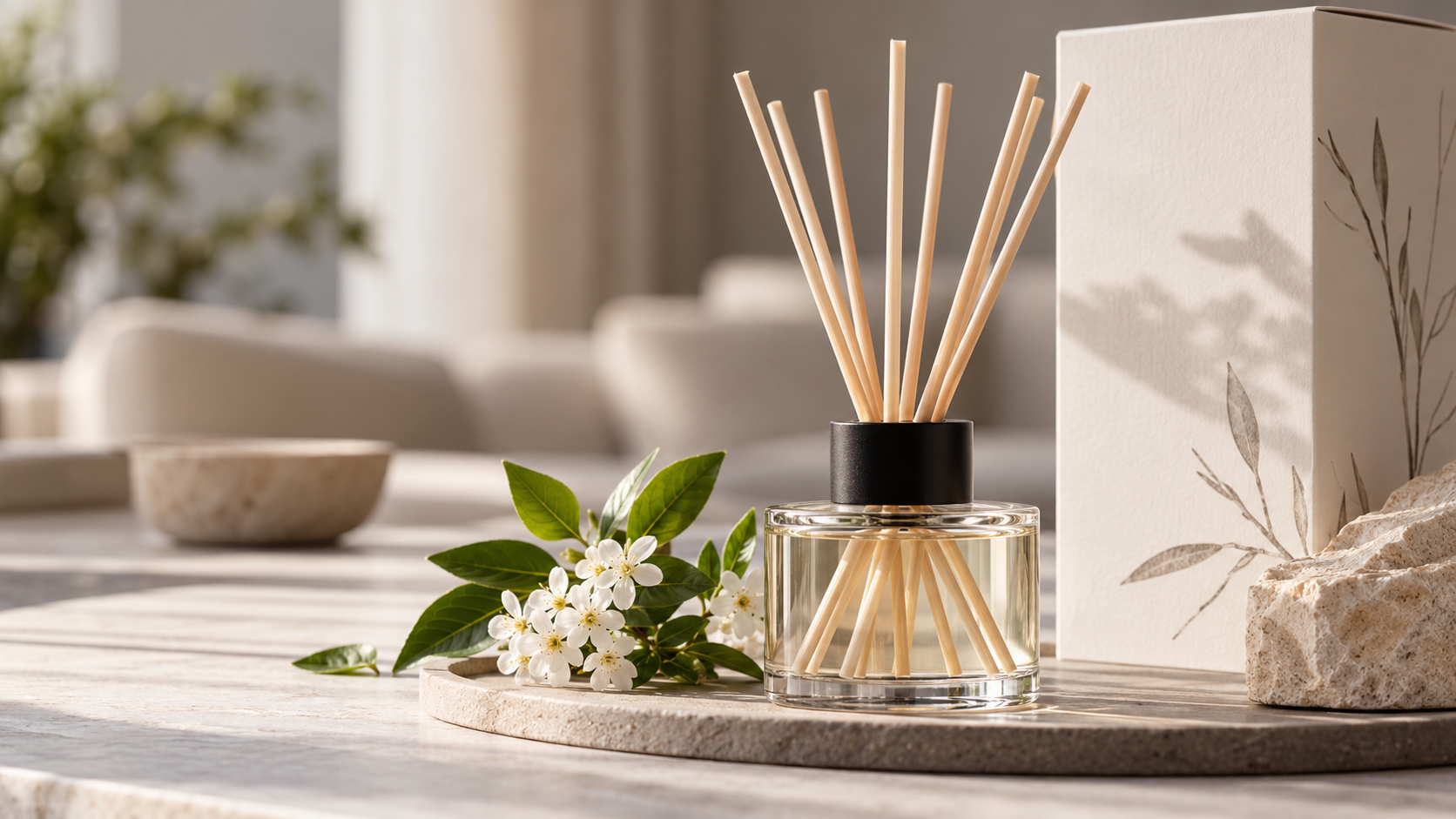
Reed diffusers: product features
Reed diffusers provide continuous room fragrance, gradually filling a space with a chosen scent. Their familiar design is simple: a bottle of fragrance liquid and a set of porous reeds. The liquid rises through capillary channels inside the reeds, and fragrance components evaporate from their surface. This keeps the room scented through a passive process, without electrical appliances, heating or mechanical spraying.
Reed diffusers are used in homes, hotels, beauty salons, offices, shops and other commercial spaces. Alongside their practical purpose, they have a decorative role and can form part of an interior design concept. Different fragrance compositions, bottle shapes and finishes allow the product to suit the space, the brand's aesthetic and personal preferences.
For perfume, cosmetics and homeware brands, a reed diffuser can be a standalone product or the starting point for a themed collection. Different fragrances, volumes and presentation options make it possible to develop a recognisable range that can later include other fragrance products. The quality of the finished product depends on a carefully matched fragrance composition, liquid base, reeds and packaging: together, these determine its performance and how customers perceive it.
Reed diffusers in interiors: home and commercial use
Scent contributes to how a space is experienced, alongside lighting, colour, materials and furnishings. It can complement a room's atmosphere, evoke associations and emphasise its individual character.
In homes, reed diffusers help maintain a pleasant scent and a comfortable atmosphere. The choice of fragrance depends primarily on personal preference. Fresh citrus and herbal scents are often associated with lightness and cleanliness, floral scents with delicacy, and woody and amber scents with warmth and comfort. These associations are not universal, but they can help people navigate the different fragrance families.
In hotels, spas, beauty salons and retail premises, fragrance can be part of the environment's design and the wider brand concept. Some projects involve developing a bespoke fragrance composition that reflects the establishment's style and positioning.
A reed diffuser's value therefore comes from its fragrance, ease of use and appearance working together. These characteristics provide the basis for a product aimed at a particular audience or application.
Reed diffuser formats: how finished products differ
Reed diffusers share the same operating principle, but can differ considerably in volume, fragrance, components and presentation. These features influence both the product's appearance and how it is used.
Bottle volume and shape. Compact diffusers suit small rooms, decorative arrangements and gift sets. Larger bottles hold more fragrance liquid. Volume alone, however, does not determine fragrance strength or how long it lasts: the formulation, reeds and conditions of use also matter.
Fragrance composition. Diffusers can contain fresh, floral, woody, amber, fruity and other fragrance compositions. Their character, intensity and evaporation behaviour affect the product experience and customers' choices.
Reed type and quantity. Natural rattan and fibre reeds differ in their material structure and liquid transport characteristics. Their diameter, length and number are selected to suit the fragrance mixture and the intended diffuser performance.
Components and presentation. A finished product may come in an individual box, gift packaging or as part of a set. Bottle design, labelling, decorative details and branding establish its visual identity.
For customers, these differences determine convenience, aesthetic appeal and suitability for personal preferences. For manufacturers, they are parameters to consider when developing the formulation, selecting components and planning the finished range.
How a reed diffuser works: from liquid to room fragrance
A reed diffuser relies on two connected physical processes: capillary transport of liquid and evaporation of volatile components.
When the reeds are placed in the bottle, the fragrance mixture enters their porous structure. Capillary forces gradually draw the liquid up through internal channels, wetting the material's surface. Volatile components enter the gas phase and disperse into the surrounding air.
Although this appears straightforward, its effectiveness depends on the combination of the liquid's physicochemical characteristics and the reeds' properties.
The main factors are:
Liquid viscosity. This affects movement through capillary channels and the rate at which the reeds become saturated.
Surface tension and the liquid's ability to wet the material. These determine how the fragrance mixture interacts with the reed surface.
Component volatility. This affects how quickly the base and fragrance materials evaporate and how the fragrance profile changes during use.
Reed porosity and geometry. These determine capillary transport conditions and the surface area available for evaporation.
Temperature and air circulation. These influence evaporation intensity and the distribution of fragrance materials within the room.
These parameters need to be considered together. For example, a more viscous base may travel through the reeds more slowly, while an overly volatile solvent system can cause the liquid to be used up too quickly.
Formulation development aims to balance product performance: sufficient fragrance intensity, an acceptable rate of liquid consumption, and the desired scent character throughout the intended period of use.
A reed diffuser's effectiveness therefore depends on the coordinated performance of the whole system, rather than a single component.
Reed diffuser construction and formulation: the role of each component
A conventional reed diffuser consists of fragrance liquid, a bottle, reeds and ancillary components. Each has a specific function, and their compatibility directly affects the finished product's characteristics.
Fragrance composition: scent character and development
A fragrance compound is a mixture of multiple aromatic materials blended to achieve a particular scent profile.
It may contain individual aroma chemicals, natural aromatic materials and supporting ingredients needed to create and maintain the composition.
A wide range of fragrance families is used in reed diffusers.
- Citrus: bergamot, lemon, orange and grapefruit.
- Herbal and green: green tea, leaves and herbal accords.
- Floral: jasmine, rose, peony and orange blossom.
- Woody: cedar, sandalwood and vetiver.
- Amber and spicy: amber accords, cardamom and cinnamon.
- Fruity and sweet: fig, peach, berries, vanilla and caramel.
Diffuser fragrances are characterised by their prolonged evaporation process. Individual aromatic materials have different volatilities, so their proportions in the liquid gradually change. The perceived fragrance may change with them.
For example, light citrus notes may be more prominent at the start, while less volatile woody or musky components can remain noticeable for longer.
Selecting a fragrance therefore involves more than assessing its initial impression. A reed diffuser needs to be evaluated throughout its working life, including possible changes in intensity and the balance between fragrance notes.
The liquid base: balancing solubility and evaporation
The liquid base dissolves the fragrance compound, carries it through the reeds and enables volatile components to be released gradually.
Reed diffuser production uses specialised liquid bases whose composition and properties are selected to suit the fragrance and the intended use of the finished product.
The choice of base depends on the technical brief and the fragrance composition. Considerations include solvency, viscosity, volatility, flash point, inherent odour and compatibility with the other product components.
Development pays particular attention to four characteristics.
Solubility and physical stability. The base should keep the mixture sufficiently uniform, without unwanted cloudiness, separation or sediment forming during the specified shelf life.
Capillary properties. The liquid needs to wet the reed material effectively and reach the evaporation surface.
Evaporation profile. The base's evaporation rate is matched to the volatility of the fragrance components and the expected product lifetime in use.
Sensory compatibility. The solvent system's inherent odour should not alter the intended scent profile in an undesirable way.
The concentration of the fragrance compound also matters. Increasing it does not always produce a corresponding increase in scent intensity, because the base's properties and the efficiency of liquid transport through the reeds also play a role.
Formulation therefore considers both the desired scent and the mixture's physicochemical behaviour. The optimum balance of ingredients is established through testing.
Reeds: the diffuser's capillary system
Reeds continuously carry fragrance liquid from the bottle to the evaporation surface. Their characteristics have a substantial influence on fragrance intensity and the rate of liquid consumption.
Natural rattan and fibre reeds are the most commonly used types in production.
Rattan reeds are made from a natural plant material with a capillary structure. Their properties can vary with the raw material and processing method.
Fibre reeds are made from specialised fibrous materials. Their structure is formed during manufacture, allowing specified porosity and geometry to be achieved.
The effectiveness of a particular reed type depends on its diameter, length, channel structure and compatibility with the liquid base.
The number of reeds also affects diffuser performance. Increasing their combined surface area may increase evaporation intensity, while also shortening the time it takes to use up a given volume of liquid.
Reeds are therefore selected and tested together with the formulation. The material alone does not guarantee better performance: what matters is how it works in the finished product.
Bottle and packaging: function and appearance
The bottle is both a functional component and an important part of a reed diffuser's visual identity.
Glass containers in different volumes, shapes and colours are widely used for conventional diffusers. Clear, frosted or decoratively finished glass allows the presentation to suit the brand concept and price segment.
Container selection considers bottle stability, neck geometry, ease of inserting reeds, material compatibility with the fragrance mixture and filling requirements.
The closure requires particular attention. Before use, the bottle must provide an adequate seal, including during storage and transport.
Presentation options include labels, printing on glass, decorative coatings, individual boxes and gift packaging.
Retail ranges benefit from recognisable, consistent design. Corporate orders require options for individual branding and alignment with the customer's visual identity.
The formulation, components and packaging together form a single product, whose technical requirements need to align with design and commercial decisions.
Reed diffuser quality: what testing reveals
Reed diffuser quality assessment covers the mixture's physical stability, fragrance diffusion, reed performance, packaging compatibility and other parameters specified in the technical brief.
It is important to assess the complete product with its agreed components, as well as the fragrance liquid on its own.
The main areas of testing are:
Physical stability. Checks cover mixture uniformity and any sediment, cloudiness, separation or colour changes during storage.
Sensory properties. Assessment covers the fragrance character, intensity and changes during use.
Capillary transport. Testing examines how well the reeds absorb liquid and carry it to the evaporation surface.
Evaporation rate. The loss of fragrance mixture mass is measured over a specified period under controlled conditions.
Packaging compatibility. Checks examine interactions between the mixture and the materials used in the bottle, closure and other components.
Seal integrity. Assessment checks the reliability of the closure and the absence of leaks during storage and transport.
A comprehensive assessment helps identify relationships between the formulation, components and the diffuser's actual performance.
Evaporation over time: what can be measured
One measure of reed diffuser performance is the rate at which the fragrance liquid loses mass.
Tests record the change in product mass over a defined period. This allows the average evaporation rate to be calculated, for example in grams per day, and different formulations or component combinations to be compared.
For valid comparisons, conditions must be comparable: the same fill volume, bottle type, number of reeds, temperature and air circulation.
However, evaporation rate and perceived fragrance intensity are different measures.
Two mixtures may be consumed at similar rates yet differ significantly in scent intensity. This reflects differences in their fragrance compositions, the volatility of individual materials and human perception of them.
Instrumental measurements are therefore complemented by sensory evaluation. Together, they provide a fuller picture of product performance and compliance with the specified requirements.
Fragrance duration and shelf life
Two different terms are used to describe reed diffusers: fragrance duration and shelf life.
Fragrance duration describes the period during which an opened diffuser releases scent in use. It depends on liquid volume, formulation, reeds and operating conditions.
Shelf life is the period during which a product should meet its approved quality specifications under the stated storage conditions.
NADEL reed diffusers have a shelf life of 24–36 months. The specific period is established individually for each product, taking into account its formulation, packaging and defined storage conditions.
Contract manufacturing: from concept to finished batch
Contract manufacturing enables entrepreneurs and companies to create reed diffusers under their own brand using a specialist manufacturer's technical and production capabilities.
This approach involves a sequence of product development stages: from defining the concept and technical brief to approving the formulation and components, producing a commercial batch and preparing it for sale.
Product concept and technical brief
The first step is to define the intended reed diffuser's characteristics.
The customer sets out the main product requirements, including:
Intended use and target audience.
Preferred fragrance family.
Expected fragrance intensity and duration.
Bottle volume and component requirements.
Design, branding and outer packaging.
Planned production quantity.
Target manufacturing cost of the finished product.
Sales countries and channels.
A finished formulation or final packaging choices are not necessary at the outset. A product concept, functional requirements and commercial objectives are sufficient to begin.
For a retail collection, priorities might include several fragrances, a consistent design and reproducible performance between batches. For a hotel or corporate customer, they might be a bespoke fragrance, branded presentation and specified components.
The manufacturer uses this information to prepare the technical brief that guides further development.
Formulation development and laboratory samples
Once the concept is agreed, the fragrance composition, liquid base and initial diffuser components are selected.
Depending on the brief, production may use existing fragrance compositions or bespoke fragrances developed to meet the customer's preferences.
Laboratory development establishes ingredient proportions, checks compatibility, and assesses mixture stability and evaporation behaviour.
Samples allow the fragrance profile and product performance to be assessed with the selected reeds and bottle.
Testing may lead to adjustments to the formulation or components. These can address fragrance intensity, liquid consumption rate, mixture stability or other agreed characteristics.
This approach allows commercial production to proceed on the basis of a tested and approved sample.
Sample approval and production specification
Once development is complete, the customer approves the final reed diffuser sample.
This establishes the formulation, fill volume, bottle characteristics, reed type and quantity, closure method, decoration and packaging.
These parameters are recorded in production documentation defining the manufacturing and quality control requirements for the finished product.
The approved sample should serve not only as a visual or fragrance reference, but also as the basis for reproducing the product's characteristics in subsequent batches.
Commercial production and batch control
Preparation for commercial production starts once the formulation and components have been approved.
The process includes measuring raw materials, preparing the fragrance mixture, checking specified parameters, filling, sealing and assembling the products.
Finished products are labelled and packed to the agreed requirements. Depending on the format, a set may contain a filled bottle, reeds, instructions and an individual box.
Consistency between batches is especially important. It is achieved by following the approved formulation, process parameters and established quality control procedures.
For the customer, this matters both for meeting the original concept and for developing the range and arranging repeat supplies.
Order quantities and reed diffuser manufacturing costs
When planning contract manufacturing, it is necessary to distinguish the quantity of fragrance mixture from the number of finished saleable units.
A production batch may be specified by the fragrance mixture's mass in kilograms, while finished products are counted as complete reed diffuser units. Calculating the number of bottles requires the mixture's mass and density, the fill volume and process losses during filling.
NADEL's production presentation lists a minimum order range of 5–50 kg for reed diffusers. Specific terms and the finished batch quantity are agreed individually according to the project's parameters.
A reed diffuser's manufacturing cost includes several main elements:
Fragrance compound and liquid base ingredients.
Bottle and closure components.
Reeds and other components.
Labels, printing and decorative finishing.
Individual and transport packaging.
Production operations, filling and assembly.
The final cost also depends on batch size, formulation complexity, packaging choices and additional customer requirements.
Commercial planning should consider the total cost of a complete product ready for sale. This makes it possible to calculate the project budget, price positioning and economics of the future range accurately.
Safety, labelling and supporting documentation
Room reed diffusers are fragrance chemical products. Their safety, classification, labelling and packaging requirements depend on the properties of the finished mixture, its intended use and the target market.
International Fragrance Association (IFRA) Standards are important when working with fragrance compounds. They set prohibitions, restrictions and specific conditions for the use of individual fragrance ingredients.
Under the IFRA classification, reed diffusers fall within Category 10A. Fragrance selection must take the relevant restrictions into account and check the permitted concentration of fragrance components in the finished product.
Compliance of a fragrance compound with IFRA Standards does not replace the safety assessment of the finished mixture or compliance with the target country's legal requirements.
Documentation requirements should be addressed during development. This allows the formulation, packaging and labelling to be aligned with the intended sales conditions in advance.
From a first fragrance to your own collection
A reed diffuser can be a standalone product or part of a wider home fragrance collection. The latter approach allows brands to build a recognisable range with a shared fragrance and visual concept.
A range can include several contrasting compositions, such as fresh citrus, floral and woody fragrances. Consistent bottle design, naming and packaging help the collection feel cohesive.
Another route is to apply a shared fragrance concept across several product categories.
For example, a composition with woody and amber accords can form the basis of a reed diffuser, room spray and scented candle. Each provides a different way to scent a room while retaining a common fragrance character.
Technical requirements differ between formats. A diffuser base, room spray formulation and candle fragrance system each need their own ingredient selection and testing.
Reed diffuser refills can be a useful addition to a range. They allow a suitable bottle to be reused and its fragrance liquid replenished. Such a product needs appropriate packaging, a compatible formulation and guidance on reed use.
NADEL's manufacturing range includes reed diffusers, refills, room sprays, scented candles and other fragrance products. This offers scope for developing individual products or complete collections under a customer's own brand.
NADEL: contract manufacturing of own-brand reed diffusers
NADEL is a Ukrainian manufacturer of perfume, cosmetics and fragrance products, specialising in contract manufacturing for brands, entrepreneurs, distributors and corporate customers.
The company provides a comprehensive approach to manufacturing projects. Cooperation can include selecting a fragrance compound, developing the formulation, making samples, choosing containers and components, filling, packaging and preparing the required documentation.
NADEL's own production and laboratory capabilities allow it to develop products for different applications, taking account of technical characteristics, intended positioning and the customer's commercial requirements.
To begin a project, define the main parameters of the future reed diffuser: fragrance family, desired volume, packaging format, planned production quantity, target manufacturing cost and sales market.
A completed formulation or finally approved design is not required at the initial stage. These can be developed and agreed during cooperation with the manufacturer.
To discuss reed diffuser production under your own brand, complete the brief on NADEL's official website. The information provided will help the team identify possible technical solutions, components and project-specific terms.