
Car fragrances: scents, formats and the details of manufacturing
Car fragrance combines a scent composition, a carefully selected base and a system that releases fragrance inside a vehicle. Explore the main air-freshener formats, their ingredients, scent intensity and duration, manufacturing processes and own-brand contract manufacturing.
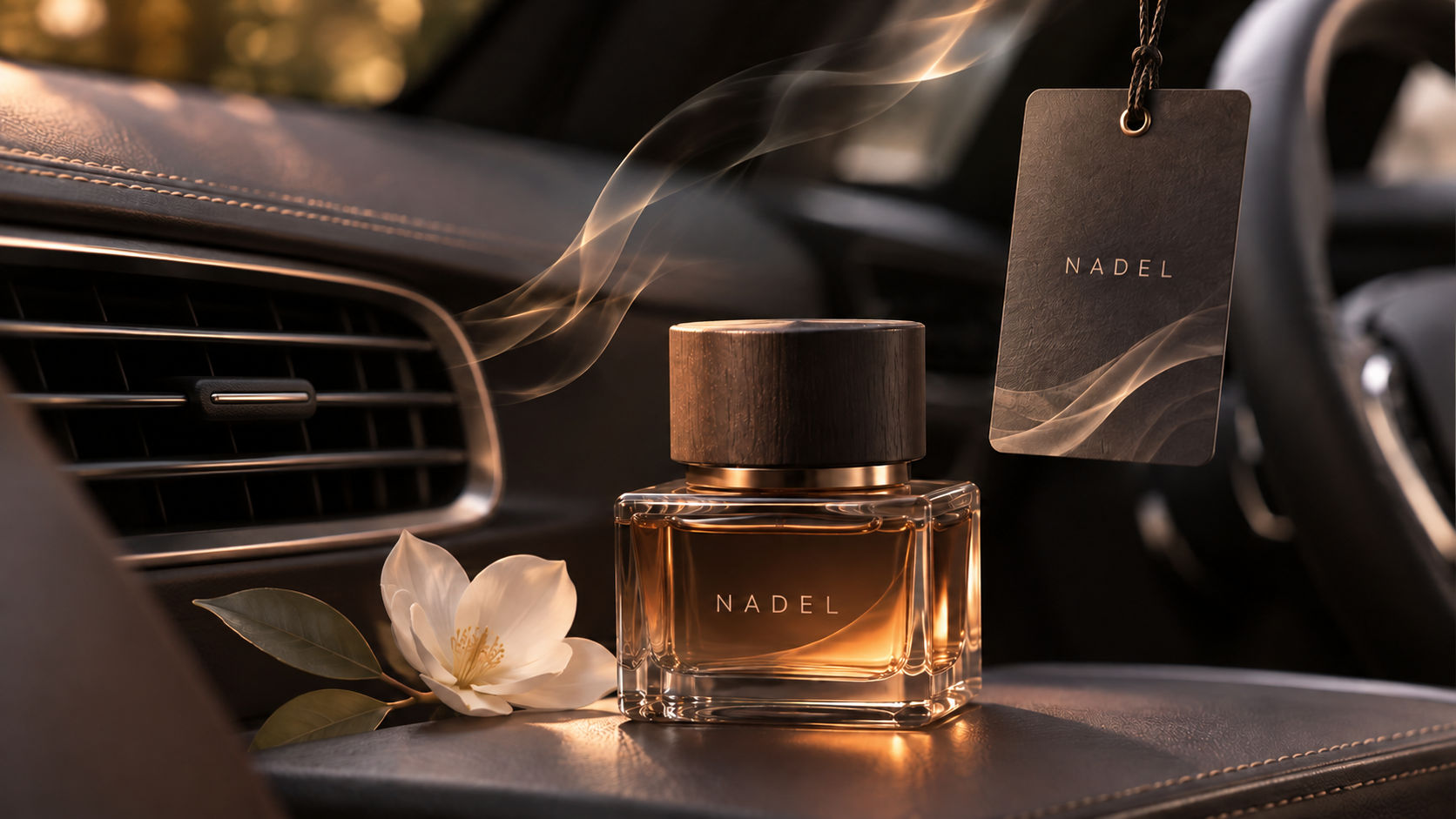
Car fragrances: scents, formats and manufacturing considerations
Car fragrance is a perfumery product designed to scent a vehicle's interior. It adds an individual fragrance suited to the driver's preferences and the car's character. Fresh citrus, delicate floral, warm woody, musky and amber compositions can create very different impressions, turning an everyday accessory into part of daily comfort.
A car has particular characteristics as a space for fragrance. Its interior is relatively small, temperatures can vary considerably, and air movement depends on ventilation, air conditioning and open windows. Fragrance character, evaporation intensity, scent duration and convenience therefore matter in car-fragrance development.
Modern car fragrances come in different formats, from compact glass bottles of scented liquid to card air fresheners, replaceable cartridges and specialised diffusers. Each has its own operating principle, construction and design possibilities. Brands can develop an individual product, a gift series or a complete collection under their own name.
Car fragrances in everyday use
A car's fragrance can be as personal as its interior design, trim materials or accessories. Some drivers prefer fresh, discreet compositions, while others favour more distinctive woody, spicy or leather scents.
Car fragrance is experienced in a confined space. Even a composition that seems light in a large room may feel stronger inside a vehicle. Air temperature, freshener placement and journey length also affect perception.
Car fragrances are used in private cars, company vehicles and other transport where suitable fragrance products can be positioned safely.
For companies, car scents can form part of a branded range. Own-brand fresheners can complement products from automotive accessory shops, car-care retailers and detailing studios, for example, or serve as corporate gifts.
In these cases, fragrance properties matter alongside product shape, design, material quality and consistency with the overall brand concept.
How car perfume differs from a conventional car air freshener
The terms car perfume, car air freshener and car diffuser are often used for related products, but may describe different characteristics.
Car air freshener is the general name for products intended to scent a vehicle's interior. This category includes card, liquid and other fragrance products.
Car perfume usually emphasises the perfumery character of a product: attention to its composition, individuality and presentation. The name is often used for compact bottles of scented liquid or other decorative fragrance systems.
Car diffuser describes a device or structure that gradually releases fragrance ingredients into the air. Depending on the format, this may occur through a porous material, membrane, airflow or another mechanism.
These names do not always imply fundamentally different chemical compositions. Actual product properties are determined by the fragrance, its base and the method of diffusion.
Main car-fragrance and air-freshener formats
Car fragrance products differ in construction, positioning and scent-release mechanism. The format affects convenience, fragrance delivery and branding possibilities.
Liquid car fragrance in a glass bottle
One characteristic format is a compact bottle of fragrance liquid. It may have a decorative cap, hanging cord or another construction designed for gradual scent release.
Some designs use a wooden or other porous cap that interacts with the fragrance liquid and gradually releases volatile components into the air. The specific activation and dosing method depends on product construction.
Glass bottles support different design options: clear or tinted glass, decorative caps, individual labels, branded engraving and gift packaging.
For liquid formats, seal integrity, secure closure, leakage resistance and compatibility between the fragrance and bottle materials are particularly important.
Card car air fresheners
Card air fresheners are made from a specialised absorbent material that holds the fragrance composition and gradually releases it into the surrounding air.
An advantage of this format is the variety of possible shapes and sizes. The card can carry brand graphics, a logo, decorative printing or a bespoke design reflecting the brand concept.
After fragrance application, the product is usually placed in protective packaging that helps limit premature evaporation during storage.
Scent-release speed depends on the absorbent material, the amount of composition applied, its volatility and usage conditions.
Card fresheners suit retail ranges, promotional series, automotive merchandise and corporate gifts. Their design can become a recognisable brand element in its own right.
Air-vent fresheners
Another common format attaches to a vehicle's air vents. It may contain a replaceable cartridge, fragranced insert, membrane or another carrier for the fragrance composition.
Air passing through the ventilation system helps transport fragrance components into the interior. Scent intensity can vary with ventilation settings and product construction.
Some systems allow adjustment of the carrier's exposed area or use replaceable refills. This adapts the scenting method to the particular device.
Development checks attachment security, structural stability, material compatibility and the fragrance element's performance under different airflow conditions.
How car fragrance spreads through a vehicle's interior
Most car air fresheners work by evaporating volatile fragrance components. Once in the gas phase, these substances disperse through the air and create a scent impression.
In liquid car diffusers, the fragrance base and its delivery to the evaporation surface are important. For card and fibre carriers, liquid absorption, material structure and the area exposed to air matter.
In vent-mounted systems, airflow past the fragrance element is an additional factor.
Each mechanism has its own characteristics, so the same composition can perform differently across car-fragrance formats.
Scent intensity and conditions of use
Car-fragrance intensity depends on the amount of aromatic substances entering the air and how people perceive them.
A scent can seem more pronounced in a small vehicle interior than in a spacious room. Open windows, active ventilation or temperature changes can also affect diffusion speed and perception.
Development needs to balance fragrance presence with comfort during prolonged exposure. Some products call for a soft, discreet scent, while others aim for a richer perfumery character.
Increasing fragrance concentration does not necessarily produce a proportional increase in scent strength. The result also depends on ingredient volatility, base properties and how effectively the carrier releases them.
What determines how long a car fragrance lasts?
Fragrance duration describes the period during which a car freshener releases composition ingredients and maintains a certain scent intensity.
For liquid formats, the amount of fragrance blend, solvent-system properties and evaporating-element construction are important. For card products, key factors are the amount of fragrance applied, the base's absorption capacity and its surface area.
Temperature, air movement, freshener placement and how frequently the vehicle is used are also important.
Heating can increase evaporation of volatile ingredients, affecting both scent strength and the rate at which the mixture is consumed. Evaporation behaviour may change at lower temperatures.
A particular product's working life is therefore established from its formulation, construction and test results. Bottle volume or card size alone does not guarantee a specific fragrance duration.
Car-fragrance compositions: families and character
The fragrance composition determines a car perfume's main individual feature: its scent. Car products can use simple compositions with a distinct leading note or complex combinations of several fragrance directions.
Fresh, citrus and green compositions may combine bergamot, lime, grapefruit, green tea, mint and herbal accords. These combinations create freshness, but their character can vary widely, from cool and restrained to bright, juicy and energetic.
Woody, leather and amber compositions may unite dry cedar and vetiver, soft sandalwood, distinctive leather and suede accords with a warm amber base. Depending on the balance of notes, they can be restrained and elegant or richer, with pronounced depth.
Floral, musky and powdery fragrances reveal notes of jasmine, rose, iris, magnolia and orange blossom. Musk and powdery accords add softness; their combination with other ingredients creates anything from light, delicate scents to more complex, multifaceted compositions.
Spicy and sweet directions can centre on cardamom, cinnamon, vanilla, tonka bean and resinous nuances. Spices add definition, while soft sweet accords create a warm, enveloping character. Together they produce scents of different intensities and personalities.
The chosen direction depends on the product idea, target audience and intended scent impression. For a brand, the composition can underpin a recognisable fragrance identity across its automotive range.
How fragrance changes during use
Fragrance compositions contain substances with different properties, including volatility. As a result, a car freshener's scent character may gradually change.
Lighter citrus, green or fruity nuances may be particularly noticeable at the start. Less volatile woody, musky and amber components can remain perceptible for longer.
This does not always follow a conventional perfume pyramid, because car-fragrance development depends on the carrier construction, evaporation mechanism and environmental conditions.
A finished product is assessed not only for its smell when first opened but also for how that smell changes during subsequent use.
Professional fragrance selection aligns the intended scent character with the particular delivery system.
Car-fragrance ingredients: composition, base and carrier
The formulation depends on format. Liquid systems mainly comprise a fragrance composition and a carefully selected base. For card and fibre fresheners, the material that holds and gradually releases aromatic substances is also important.
Development assesses ingredient compatibility, physical stability, volatility, scent properties and interactions with packaging.
Fragrance composition
A fragrance composition, or fragrance compound, is a mixture of aromatic ingredients developed to achieve a defined scent profile.
It may contain natural aromatic materials, synthetic fragrance substances and supporting components needed to create the composition.
Selecting a car fragrance involves assessing its initial scent and its behaviour in a particular carrier. The same composition may perform differently in a bottle diffuser, card freshener or replaceable cartridge.
The scent profile is therefore assessed in the finished product, taking account of the evaporation method and desired intensity.
Liquid base and solvent system
In liquid car fragrance, the base provides the necessary fragrance solubility and influences release behaviour.
Specialised solvent systems may be used, with their composition selected according to the technical brief, fragrance properties and product construction.
Selection considers solvency, volatility, viscosity, flash point, inherent odour and compatibility with bottle materials.
Physical stability is particularly important. The formulation should retain the required uniformity, intended appearance and characteristics throughout the specified storage period.
Fragrance concentration is chosen with regard to the desired scent intensity, base properties and relevant conditions for using fragrance ingredients.
Absorbent materials and fragranced carriers
In card and fibre fresheners, the carrier is a functional part of the product. It must absorb a defined amount of fragrance, retain it and allow gradual evaporation.
Specialised absorbent card, fibrous materials and other porous bases can be used for this purpose.
Important characteristics include absorption capacity, thickness, density, material structure and compatibility with the fragrance liquid.
Development checks how the carrier changes after fragrance application, whether it retains its required shape and how it affects ingredient release speed.
Car-fragrance containers and packaging: construction, sealing and design
A car freshener's packaging affects storage conditions, usage method and the overall visual impression.
Liquid car fragrances can use compact glass bottles in different shapes. Depending on the design, they are equipped with caps, seals, hanging elements or specialised evaporation components.
Component selection pays particular attention to bottle seal integrity, compatibility with the fragrance liquid and attachment reliability.
For card fresheners, packaging has a different role: helping preserve fragrance properties before use. Appropriate barrier packaging materials are used for this purpose.
Design can include printing, brand colours, individual shapes, decorative finishes, labels and gift boxes.
Car-fragrance packaging combines decorative and functional roles. The product should reflect the brand concept, be convenient to use and maintain its required characteristics in a vehicle interior.
Using car fragrance inside a vehicle
Car air fresheners operate under conditions that may differ substantially from ordinary indoor fragrance use.
Vehicle interiors can experience significant temperature fluctuations, sunlight, vibration during driving and changes in air exchange. These factors are considered when selecting the formulation, carrier and construction.
High temperatures may accelerate fragrance evaporation and change scent intensity. For liquid systems, mixture stability and packaging reliability are also assessed.
Low temperatures can affect certain fragrance bases, including viscosity, ingredient solubility and evaporation rate.
Sunlight can affect the stability of some fragrance substances and decorative materials. Development may therefore check changes in colour, appearance and fragrance profile.
Vehicle vibration and movement impose additional requirements on attachments, closures and structural stability.
Liquid fresheners must prevent the fragrance blend from contacting interior trim. Certain solvents and concentrated compositions may be incompatible with plastic, painted, varnished and other surfaces.
Car fragrances must be positioned according to the manufacturer's instructions so that they do not restrict the driver's view, interfere with controls or obstruct vehicle safety systems.
Suitable materials and construction help align fragrance properties with practical usage conditions.
Car-fragrance manufacturing and quality control
Manufacturing technology depends on format. Liquid products mainly involve preparing the fragrance mixture, checking it and filling. Card fresheners require preparation of the absorbent base, application of fragrance and protective packaging. Each stage must maintain formulation stability and reproducible finished-product characteristics.
Raw material and component preparation. Before manufacture, the fragrance composition, base ingredients, carrier materials, containers and other elements are checked against approved specifications.
Preparing the fragrance mixture. The fragrance compound is combined with the ingredients specified in the formula. Mixing controls cover ingredient ratios, addition order, uniformity and other process parameters.
Filling or fragrancing the carrier. Liquid blends are dispensed into prepared bottles. Card products receive fragrance on the absorbent material, with controls on quantity and even distribution.
Closing and packaging. Bottles receive caps, seals, hanging elements and other specified components. Card fresheners are placed in protective packaging to help preserve their properties until use.
Quality control covers fragrance, physicochemical and functional characteristics. The main checks include:
- Fragrance profile. Agreement with the approved sample, scent intensity and how the composition develops.
- Formulation stability. Retention of the required uniformity, appearance and scent properties under defined storage conditions.
- Carrier performance. The absorbent material, membrane or other element's ability to retain and gradually release the composition.
- Seal integrity and packaging compatibility. Closure reliability, absence of unwanted leakage and interactions between the fragrance mixture and product materials.
- Thermal and mechanical resistance. Product behaviour under defined temperatures, attachment security and retention of structural integrity.
- Presentation quality. Compliance of shape, printing, colour, labelling and components with the agreed requirements.
Fragrance intensity and duration are assessed separately. Formulation comparisons may track changes in fragrance-mixture mass over a defined period. These measurements help assess evaporation rate under comparable temperature, airflow and product-construction conditions.
Evaporation rate and perceived scent strength are not the same measurement. Two compositions may be consumed at similar rates yet differ in fragrance intensity. Instrumental measurements are therefore complemented by sensory sample comparison, assessing the composition's character and how it changes during use.
After manufacturing, finished products are checked against the approved sample. This helps maintain a consistent fragrance profile, functional characteristics and presentation quality between batches.
Own-brand car-fragrance contract manufacturing
Creating an own-brand car fragrance begins with its scent concept and finished-product format. The formulation, carrier or bottle construction, packaging, conditions of use and quality requirements must then be agreed.
Contract manufacturing brings these stages together through cooperation with a specialist manufacturer. Brands can create their own car scents using professional expertise in fragrance compositions and scented products.
Car-fragrance concept and technical brief
The first stage defines the future product's characteristics.
The brief considers:
- Product purpose and target audience.
- Desired fragrance direction and composition character.
- Freshener format and positioning method.
- Expected scent intensity and duration.
- Packaging shape, materials and construction.
- Design, branding and additional components.
- Planned production quantity.
- Target manufacturing cost of the finished product.
- Sales markets and channels.
An automotive brand or detailing studio may, for example, value a bespoke fragrance composition, branded design and a convenient usage format.
A retail range may prioritise several scents, a shared presentation concept and repeat production batches with agreed characteristics.
At the outset, defining the main preferences is sufficient. Specific formulation, construction and process solutions are determined during subsequent development.
Fragrance selection and laboratory samples
Once the concept is agreed, the approach to fragrance creation is determined.
One option is selecting a composition from a professional fragrance library. This allows different scent directions to be compared and a solution chosen that fits the future product's concept.
Another option is bespoke fragrance development according to a technical and creative brief.
After scent selection, the required base, concentration and carrier format are defined. Laboratory samples are prepared for further approval.
Samples are assessed for fragrance character, intensity, stability, carrier compatibility and evaporation behaviour. Testing may lead to formulation adjustments until the desired characteristics are achieved.
Design development and component selection
The car fragrance's appearance is developed alongside its formula.
For bottle formats, this defines container shape and volume, cap construction, attachment method, decorative finish and individual packaging.
Card fresheners can use a bespoke shape, graphics, hanging system and protective packaging.
Material selection considers fragrance compatibility, functional construction, packaging reliability and reproducibility in commercial production.
Thoughtful presentation brings the product's fragrance character together with the brand's visual identity.
Product approval and commercial production
When development is complete, the customer approves the final car-fragrance sample and finished-product components.
The approved sample establishes the main formulation, fragrance and functional characteristics, packaging parameters and quality requirements.
A production specification is then prepared, followed by organising material purchases, fragrance manufacture, filling or carrier fragrancing, and packaging.
The customer needs a finished own-brand product with the agreed characteristics and required components.
Car-fragrance production quantities and costs
Contract manufacturing planning defines fragrance-mixture volume, finished-product quantity, packaging format and target manufacturing cost.
Liquid-format calculations can use bottle fill volume and saleable unit count. For card fresheners, important parameters are the number of card bases, fragrance consumption and packaging method.
The main cost elements are:
- Fragrance composition. Its ingredients, concentration, raw material cost and purchase quantity.
- Fragrance base. Ingredients required to achieve the agreed finished-product properties.
- Carrier or container. Glass bottle, card base, cartridge or another structural element.
- Components. Caps, seals, hanging elements, clips and other parts.
- Design and branding. Printing, labels, decorative finishes and bespoke shapes.
- Packaging. Protective pouches, boxes, gift presentation and transport packaging.
- Manufacturing operations. Mixture preparation, filling, carrier fragrancing, quality control and packaging.
- Development and documentation. Work required to create the product and prepare it for sale.
Final cost also depends on structural complexity, the number of fragrances, design customisation, batch size and material purchasing terms.
Commercial planning should consider the complete cost of a fully assembled car freshener ready for sale.
Minimum production quantity and specific order terms are agreed individually according to format, formulation, components and project parameters.
From a single fragrance to your own car-perfume collection
Car fragrance can be a standalone product or part of a broader scented-product range. Brands can create their own collection of automotive scents united by a shared concept.
A range may contain compositions with different characters: fresh citrus, a soft floral-musky scent, a woody fragrance or a richer amber direction.
Coordinated bottle and card designs, naming and packaging help form a recognisable range.
Another development option is offering one scent in several formats. A composition can be adapted for liquid car perfume, a card freshener and an air-vent-mounted system, for example.
Each format nevertheless requires its own base selection, concentration, construction and testing, because diffusion mechanisms and usage conditions differ.
For automotive brands, accessory shops, detailing centres and corporate customers, car fragrance can become part of a branded product or gift offering.
Another promising direction combines car and home fragrances within one brand scent concept. A composition's character can be developed through car perfume, a reed diffuser and a room spray, adapting it to each product's technical requirements.
NADEL: own-brand car-fragrance contract manufacturing
NADEL is a Ukrainian manufacturer of perfume, cosmetics and fragrance products, specialising in contract manufacturing for brands, entrepreneurs, distributors and corporate customers.
The company's manufacturing range includes car perfumes and car diffusers alongside other perfumery and fragrance products.
NADEL combines perfumery, laboratory and manufacturing expertise to offer a comprehensive approach to own-brand product creation.
Cooperation may cover concept development, fragrance selection or creation, formulation, sample manufacture, choice of containers and components, filling, packaging and preparation of required documentation.
A complete car-fragrance contract manufacturing service combines fragrance development, processing and finished-product assembly within one manufacturing project.
To begin cooperation, define the main preferences: fragrance direction, desired car-freshener format, composition character, design, planned quantity, price positioning and sales market.
A finished formulation or finally approved design is not essential at the outset. These can be developed and agreed with the company's specialists during product development.
To discuss creating your own car perfume or launching a car-freshener collection under your brand, complete the brief on NADEL's official website. Based on your concept, the team will help identify possible fragrance, formulation and construction solutions, components and individual manufacturing terms.