
Eau de parfum: how a fragrance and its finished product are created
Eau de parfum brings together the art of scent creation, perfume formulation and modern manufacturing. Explore its composition, concentration, longevity, note development, quality requirements and the possibilities of own-brand contract manufacturing.
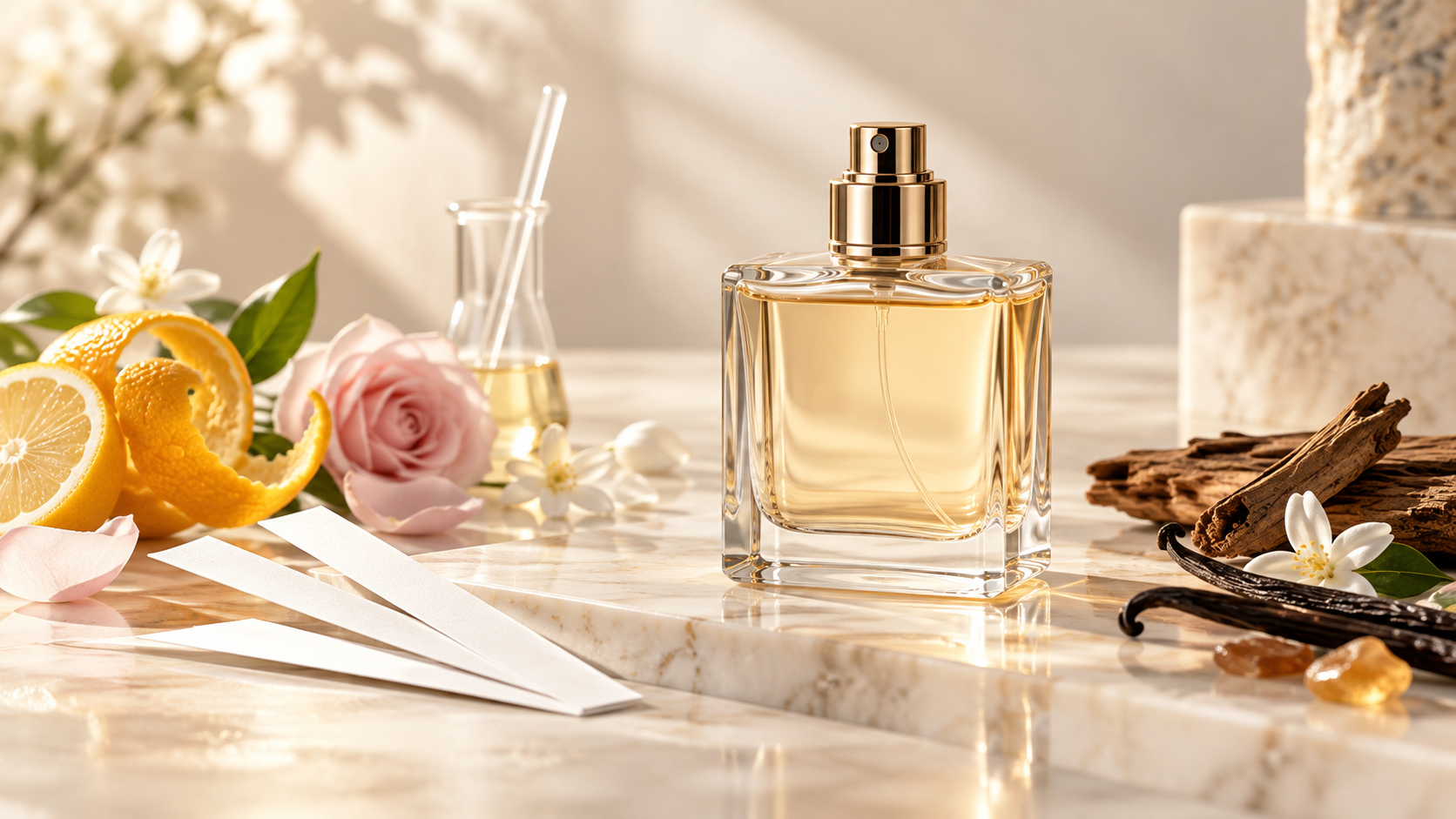
Eau de parfum: from fragrance creation to the finished bottle
Eau de parfum (Eau de Parfum, EdP) is one of the most common forms of modern perfumery. It usually contains a fragrance composition, a perfume base and supporting ingredients. Their selection and proportions influence the finished product's properties, ease of application and storage stability. Eau de parfum encompasses many fragrance families: floral, citrus, woody, spicy and others. They differ not only in scent character, but also in intensity, longevity and sillage. Even with a similar set of notes, two fragrances can be perceived differently, because the proportions of aromatic ingredients and the characteristics of the finished formulation play an important role.
Eau de parfum holds a distinctive place in cosmetics. Its value lies in a multifaceted olfactory experience that extends beyond the first minutes after application. Each composition has its own character, intensity and way of developing, giving the fragrance its individuality.
Creating eau de parfum combines a perfumer's creativity with the precision of cosmetics manufacturing. Behind the finished bottle are fragrance development, selection of concentration and perfume base, sample preparation, testing, packaging design and quality control. For brands, this offers opportunities to create both individual signature fragrances and complete perfume collections under their own name.
What distinguishes eau de parfum from other fragrance formats?
Eau de parfum is among the most widely used formats in modern perfumery. Its relatively high concentration of fragrance composition allows expressive, multifaceted scents with varying intensity and sillage.
Concentration describes the proportion of fragrance composition in the finished product. For eau de parfum, approximately 10–20% is a common reference range, although actual values depend on the manufacturer, composition and formulation concept. There is no single universal percentage mandatory for every product labelled Eau de Parfum.
By comparison, eau de toilette (Eau de Toilette, EdT) generally has a lower fragrance concentration, while perfume extract (Extrait de Parfum, Parfum) has a higher one. These formats may also differ in the construction of the fragrance itself: the balance of notes, the way it develops and its overall intensity.
However, eau de parfum is not necessarily just a more concentrated version of an eau de toilette. Even within the same fragrance line, a manufacturer may structure the compositions differently, changing the emphasis and ingredient proportions.
The quality and character of eau de parfum therefore depend not only on the percentage of fragrance composition, but above all on its ingredients, structure and development in the finished product.
Fragrance composition: structure and scent creation
The fragrance composition defines the main reasons for choosing an eau de parfum: its scent, character, mood and olfactory expression.
A professional fragrance composition may contain dozens of aromatic ingredients. It can be created from natural aromatic raw materials, synthetic aroma substances or a combination of both. Each ingredient is selected according to its scent properties, intensity, volatility and role in the overall structure.
Some ingredients create a vivid first impression, others establish the composition's main character, and some add depth and influence how long the scent remains perceptible.
Skilfully combining these properties produces a coherent fragrance with its own structure and recognisable character.
Top notes, the heart and the base
Perfumery uses the concept of a fragrance pyramid to describe how a scent develops. It broadly divides the composition into three levels and helps explain which nuances may dominate at different stages.
Top notes form the opening impression. They are often light, fresh and bright nuances of bergamot, lemon, mandarin, green or fruity accords. The greater volatility of the corresponding ingredients makes them especially noticeable in the first minutes after application.
Middle notes, or the heart, define the composition's main olfactory theme. Floral, spicy, fruity and other accords may emerge here: jasmine, rose, iris, lavender, cardamom or peach. The heart often gives a fragrance its most recognisable character.
Base notes provide depth and the final impression. They include woody, musky, ambery, resinous and sweet accords, such as sandalwood, cedar, patchouli, vanilla and tonka bean.
The fragrance pyramid is a way of describing a composition, rather than a strict sequence in which individual ingredients appear. Many aromatic components can be perceived from the outset, and some contemporary compositions maintain a relatively consistent character throughout wear.
It is also important to distinguish a note from an ingredient. The scent impression of a particular flower or fruit, for example, may be created by combining several aroma substances. In that case, the note describes an olfactory impression, rather than necessarily indicating the presence of a specific natural extract.
Fragrance families and their character
Modern perfumery offers many fragrance families, which can be expressed individually or combined in complex, multifaceted compositions.
Floral fragrances are built around rose, jasmine, peony, orange blossom, iris and other floral notes. They can be light and transparent, rich or soft, with powdery and musky nuances.
Citrus and fresh compositions often combine bergamot, lemon, grapefruit, mandarin, green accords and aromatic herbs. These combinations create an impression of freshness, lightness and energy.
Woody and musky fragrances feature cedar, sandalwood, vetiver, patchouli and various musk accords. Depending on the formulation, their character may be dry, warm, soft or enveloping.
Ambery, spicy and sweet families combine vanilla, cinnamon, cardamom, resinous ingredients, tonka bean and other warm scent nuances. Such compositions are often characterised by richness, depth and a distinctive drydown.
Chypre, fougère, fruity, powdery and other compositions also have their place. Modern fragrances frequently blend several families to create complex and original scent profiles.
For consumers, fragrance choice is often linked to personal preferences, mood and style. For a brand, the fragrance family provides a foundation for product positioning, around which its name, visual concept and the overall identity of the perfume line can be developed.
Longevity, intensity and sillage: how a fragrance is perceived
Eau de parfum is characterised not only by its notes but also by how they emerge after application. Longevity, intensity and sillage are particularly important when evaluating the finished product.
Longevity describes how long the fragrance remains perceptible after application. It depends on the composition, ingredient volatility, concentration, conditions of use and individual skin characteristics.
Intensity describes the strength of the olfactory impression. Some compositions are vivid from the first spray, while others unfold gradually and have a more restrained character.
Sillage is the scent trail perceived in the space around a person. It may remain delicate and close to the skin, or be more pronounced and expansive.
These characteristics are related but not identical. A fragrance may, for example, remain noticeable directly on the skin for a long time while producing a fairly soft trail. Another composition may have a striking opening that gradually becomes less intense.
Temperature, the amount applied and individual skin characteristics also affect development. The same eau de parfum can therefore be perceived somewhat differently under different conditions of use.
Development assesses not just fragrance concentration, but the actual character of the finished scent. Perfume blotters, sensory comparison of samples and appropriate skin testing are used for this purpose.
Eau de parfum ingredients: fragrance composition and perfume base
A conventional eau de parfum formulation contains a fragrance composition, an alcohol base and, depending on the formula, water and supporting ingredients. Their proportions are selected according to the required concentration, raw material properties and finished-product characteristics.
Development pays particular attention to ingredient solubility and compatibility, the mixture's clarity and preservation of its properties throughout the specified shelf life.
How the fragrance composition expresses itself
For eau de parfum production, it is important to assess how the composition performs within the finished formula. Once incorporated into the perfume base, its actual scent character, the mixture's clarity and fragrance stability can be checked.
Alcohol base and water
In conventional eau de parfum formulations, the main solvent is usually perfumery-grade ethyl alcohol, including denatured alcohol, which may appear in the cosmetic ingredient list as Alcohol Denat.
Alcohol dissolves the fragrant ingredients, helps distribute the product evenly during application and gradually evaporates after spraying, allowing the fragrance to be perceived.
Water (Aqua) may be used to adjust the base composition. Its quantity is determined by the required ingredient solubility, clarity and stability of the finished mixture.
Some formulations also use supporting solvents, stabilisers, colourants or other functional ingredients. These are selected according to the properties of the fragrance composition and finished-product requirements.
Once the composition is agreed, the formulation is documented for laboratory sample preparation and further stability assessment. This establishes the required eau de parfum characteristics and helps reproduce them during commercial manufacturing.
Bottle and packaging: completing the fragrance's identity
The bottle is an important part of the finished eau de parfum. It stores the product, makes application convenient and creates the first visual impression of the fragrance.
The most common solution remains a glass bottle with a spray pump. Glass allows different shapes and transparent, tinted or decorated surfaces, helping express the fragrance composition's character.
The spray pump's design is particularly important. It affects the quantity dispensed per press, distribution uniformity, droplet size and application comfort.
Perfume bottles may use crimped or screw-on fastening systems. The choice depends on the neck design, spray pump type and packaging seal requirements.
A cap, decorative elements, label and individual box complete the presentation. Depending on the price segment, options may include understated designs, decorative glass colouring, metallised elements, embossing and other finishes.
Component selection includes checking compatibility with the eau de parfum, bottle seal integrity, spray pump performance and durability of decorative coatings.
Thoughtful packaging brings together the scent, its name and visual concept in a coherent product that reflects the brand's positioning.
How eau de parfum is manufactured: the production process
Eau de parfum manufacturing combines work with aromatic raw materials, precise ingredient dosing, control of process parameters and preparation of the finished product for filling.
Once the formulation is approved, the required production operations, ingredient addition sequence and mixture-processing conditions are defined.
Raw material preparation. Before manufacture, the fragrance composition, alcohol base, water and other ingredients specified in the formula are checked. Approved specifications and suppliers' supporting documentation are used for control.
Mixing. The fragrance composition is incorporated into the prepared base according to the manufacturing instructions. Ingredient proportions, temperature conditions and mixture uniformity are controlled during mixing.
Stabilisation and resting. Some formulations require a resting period, often called maceration in perfumery. This may form part of stabilising the mixture after blending. Whether this stage is needed and how long it lasts depend on the particular formula.
Cooling and filtration. Additional processing is used where needed to achieve the required clarity and uniformity of the finished eau de parfum.
Filling. After the specified controls, the product is dispensed into bottles of the appropriate volume. Filling accuracy, container cleanliness and compliance with agreed manufacturing parameters are important at this stage.
Assembly and packaging. Spray pumps and caps are fitted, seal integrity is checked, and bottles are labelled and packed into suitable boxes.
The production process aims to ensure fragrance stability and reproducible finished-product characteristics from batch to batch.
Eau de parfum quality control
Quality control covers the product's olfactory, physicochemical and functional characteristics. It takes place during formulation development, sample approval and commercial manufacturing.
The main areas of assessment include:
- Fragrance profile. Agreement with the approved sample, how the composition develops and the harmony of its notes.
- Clarity and uniformity. Absence of unwanted cloudiness, sediment or other appearance changes.
- Colour. Conformity with agreed characteristics and stability during storage.
- Intensity and longevity. Assessment of scent strength and how long it remains perceptible under defined test conditions.
- Formulation stability. Retention of required product characteristics over time and under the intended storage conditions.
- Packaging compatibility. Interaction between the eau de parfum and the bottle, spray pump, seals and other component materials.
- Spray pump performance. Consistency of product delivery, spray pattern and system seal integrity.
Comparing finished products with the approved reference sample is an important part of control. It helps maintain a consistent scent profile and other characteristics in repeat production batches.
Eau de parfum's shelf life is established with regard to its formulation, packaging, relevant test results and defined storage conditions.
Documentation and professional manufacturing support
Creating eau de parfum involves preparing technical documentation for aromatic raw materials and the finished cosmetic product.
Documentation helps formulators control ingredient characteristics, determine conditions of use, develop the formulation and prepare products for sale.
International Fragrance Association (IFRA) Standards play an important role. Conventional eau de parfum intended for application to the skin falls within IFRA Category 4.
An IFRA Certificate provides information on a specific fragrance composition's compliance with applicable IFRA Standards and permitted concentrations for the relevant product categories. These data are considered when selecting the working concentration in the finished formulation.
An Allergen Declaration provides information on fragrance allergens in the composition. It is used to calculate their levels in the finished eau de parfum when preparing the ingredient list and labelling for the target market.
A Specification defines the characteristics and established quality parameters of an aromatic raw material, while a COA (Certificate of Analysis) records the control results for a particular batch.
An SDS (Safety Data Sheet) provides information for professional storage, transport and safe handling of aromatic raw materials. Relevant REACH requirements and the GHS system for classifying chemical substance and mixture hazards are also considered when working with suppliers.
For the finished eau de parfum, work includes formulation documentation, the INCI ingredient list, necessary test results and labelling. Depending on the sales market, support may include a Product Information File (PIF), a Cosmetic Product Safety Report (CPSR) and the relevant notification procedure.
In Ukraine, cosmetic product requirements are set out, among other provisions, in the Technical Regulation on Cosmetic Products, taking account of its current version and transitional provisions. For international market entry, the requirements of the respective countries are also considered.
Comprehensive documentation support is an important part of professional own-brand eau de parfum manufacturing and helps prepare a product for the planned sales channels in advance.
Production quantities, formats and eau de parfum manufacturing costs
Planning contract manufacturing includes defining the batch size, filling format and target manufacturing cost of the finished product.
Eau de parfum can be produced in different volumes, from compact travel bottles to conventional sizes for regular use. The choice depends on brand positioning, the target audience and sales channels.
Production quantity calculations consider the volume of perfume liquid, number of saleable units, filling parameters and necessary component material allowances.
Eau de parfum's manufacturing cost consists of several main elements:
- Fragrance composition. Its cost depends on the ingredients, raw materials used, supplier and purchase volume.
- Perfume base. Alcohol, water and supporting ingredients specified in the formulation.
- Bottle and components. Glass, spray pump, cap, sealing and decorative elements.
- Decorative finishing. Colouring, printing, labels, embossing and other design treatments.
- Individual packaging. Box, internal elements and additional accessories.
- Manufacturing processes. Mixture preparation, processing, quality control, filling and packaging.
- Development and documentation support. Work required to create a new product and prepare it for sale.
The final cost is also affected by fragrance concentration and composition, the number of scents in the collection, the extent of design customisation, production volume and component purchasing terms.
The minimum production quantity and specific order terms are agreed individually according to the formulation, bottle format and project characteristics.
From an individual scent to your own perfume collection
Creating own-brand eau de parfum can begin with a single composition that reflects the brand's character and becomes its recognisable signature scent.
The range can subsequently expand through compositions with different moods and characters. One collection might, for example, bring together a fresh citrus fragrance, a soft floral-musky composition and a rich woody-ambery scent.
A consistent brand concept plays an important role in building a perfume line. Shared bottle design, naming conventions, packaging and visual elements help unite different scents into a coherent range.
Another development option is to offer one fragrance in several formats: a conventional bottle, a compact travel version, a miniature set or discovery samples. These options introduce consumers to the compositions and provide different ways to use them.
For a brand, eau de parfum can form the basis of its own olfactory identity, later developed through new compositions, themed collections and an expanded range.
NADEL: complete eau de parfum development and contract manufacturing
NADEL is a Ukrainian manufacturer of perfume, cosmetics and fragrance products, specialising in contract manufacturing for brand owners, entrepreneurs, distributors and companies developing their own ranges.
The company combines perfumery, laboratory and manufacturing expertise to provide a comprehensive approach to own-brand product development.
Within a project, NADEL can support the main stages of eau de parfum development: from concept and fragrance selection or creation to sample production, formulation development, bottle selection, filling, packaging and preparation of the required documentation.
A complete eau de parfum contract manufacturing service brings fragrance development, production processes and assembly of the finished product together within a single project.
To begin cooperation, it is enough to define the main preferences: fragrance family, desired composition character, bottle format, price positioning, planned production quantity and sales market.
A finished formulation or finally approved design is not essential at the outset. These decisions can be developed and agreed with the company's specialists during product development.
To discuss creating your own eau de parfum or launching a perfume line, complete the brief on NADEL's official website. Based on your concept, the team will help identify possible fragrance and formulation solutions, components and individual manufacturing terms.