
Hand cream: how a daily care formula is developed
Hand cream combines moisturising, softening and protective properties that depend on its composition and structure. Explore how it works, key cosmetic ingredients, emulsion systems, texture development, quality control and the stages of own-brand contract manufacturing.
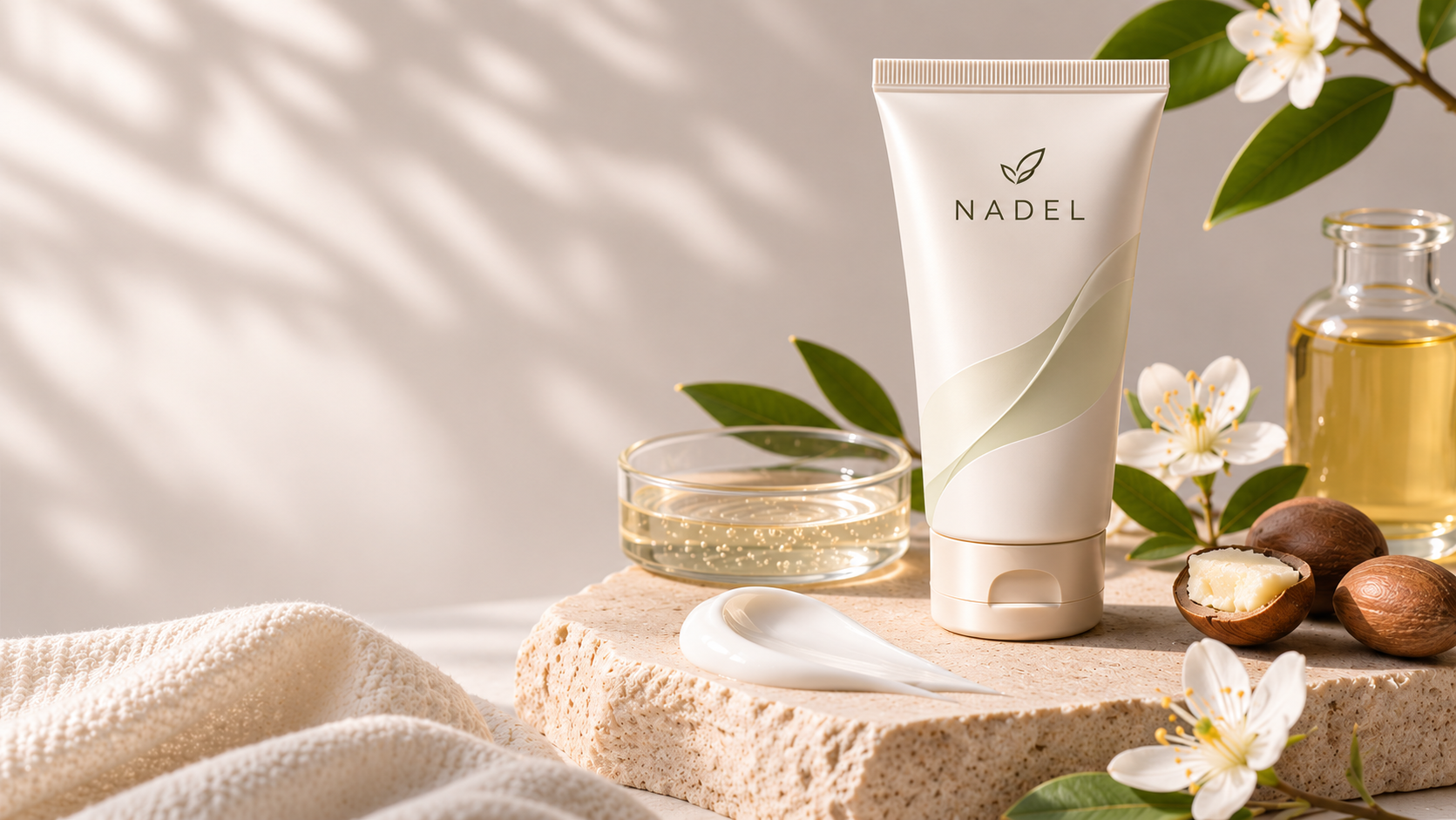
Hand cream: how a daily care formula is developed
Hand cream is a cosmetic product that helps maintain skin hydration, softness and comfort. It is used after handwashing and throughout the day when the skin needs additional care. Depending on the formulation, a cream may combine moisturising, softening and protective properties, leaving a thin layer of ingredients on the skin surface that helps reduce moisture loss.
Hand cream's particular requirements reflect its everyday use. Hands repeatedly come into contact with water, cleansers, different surfaces and the environment. Care properties therefore matter alongside consistency, ease of spreading, absorption feel and the sensation after application. A balanced formulation can combine a light, pleasant texture with effective moisturising and softening.
Behind this familiar cosmetic product lies a carefully developed formulation. The balance of water and oil phases, choice of moisturisers, emulsifiers, fragrance composition and packaging determine the finished cream's properties. This allows cosmetics brands to create products with different textures, functional characteristics and individual presentation.
Hand cream in everyday care
The skin of the hands is exposed daily to water, temperature changes, dry air and regular cleansing. These factors can affect its protective surface layer, including its ability to retain moisture.
Hand cream complements regular hygiene with skin care. It is convenient to use after washing to support softness and reduce dryness. For frequent use, easy spreading, pleasant consistency and a comfortable after-feel are especially important.
At home, cream choice often depends on individual skin characteristics and usage habits. Some consumers prefer light formulas that spread quickly and leave little residual film. Others choose richer textures designed to provide more intensive softening.
In beauty salons, spas and hotels, hand cream can complement the main cosmetics offering. After hand cleansing or a beauty treatment, for example, it becomes the final care step. Its fragrance, texture and bottle design can reflect the establishment's overall concept.
For brands, hand cream is a versatile category that can be offered as a standalone product or included in a skin-care range. Its consumer characteristics are shaped primarily by the formulation, rather than simply by individual ingredients or external presentation.
How hand cream helps the skin retain moisture
A cream's moisturising action relates to the skin's structure. Its outer layer, the stratum corneum, contains cells and lipid components involved in maintaining the natural protective barrier.
To preserve softness and suppleness, this layer needs to retain sufficient moisture. Cosmetic creams help maintain its balance by combining ingredients with different functions.
Humectants. These substances attract and retain water in the skin's surface layers. Common examples include glycerin, urea and other hygroscopic ingredients.
Emollients. These help smooth the skin surface, improve its tactile properties and reduce the feeling of roughness. This group includes various cosmetic oils, esters and lipid ingredients.
Ingredients that reduce moisture loss. These form a layer on the skin surface that helps limit water evaporation. Certain silicones, petrolatum and other substances with suitable properties may be used for this purpose.
These mechanisms are often combined in a cosmetic formulation. A humectant, for example, helps retain water, while emollient and protective ingredients form a comfortable layer on the skin surface.
The cream can consequently help maintain hydration, improve the feeling of softness and support the skin's natural comfort at the same time.
Care effectiveness depends on the whole formula: ingredient types, concentrations, compatibility and the properties of the finished emulsion.
Hand cream textures and formats
Hand creams can differ in consistency, spreading behaviour and after-feel. These properties are determined primarily by the emulsion system and ingredient proportions.
Light cream for daily use. This has a soft, easily spread texture and generally leaves only a light film sensation. It suits concepts designed for regular care throughout the day.
Rich emollient cream. This may contain a higher proportion of lipid ingredients or a different combination, producing a more pronounced softening sensation. Such formulas are developed around the desired moisturising and protective characteristics.
Cream with barrier-supporting properties. These formulas focus on ingredients that help reduce moisture loss and support the skin surface's protective functions. The finished product's actual properties are assessed through appropriate testing.
Fragranced hand cream. This combines care properties with an individual scent. It can be created as a standalone cosmetic or as part of a brand's fragrance collection.
Cream without added fragrance. This format uses a formula without a fragrance compound. Individual cosmetic ingredients may nevertheless have an inherent odour, which is considered during development.
These formats are not rigid technical categories. A light cream may, for example, have substantial moisturising properties, while a rich formula may spread well and leave a pleasant after-feel.
For the manufacturer, it is therefore important to define not just the desired thickness but the complete sensory profile: spreading, absorption feel, residual sensation and skin comfort.
The emulsion base: how a cream's texture is formed
Most conventional hand creams are made as emulsions: systems in which water and oil components are brought together into a uniform-looking product using carefully selected emulsifiers.
Water and oil do not normally form a stable, uniform mixture. In a cosmetic emulsion, one liquid phase is dispersed as small droplets within the other. Emulsifiers help create and maintain this structure.
Two main emulsion types are used for creams.
Oil-in-water (O/W). Small droplets of the oil phase are dispersed in an aqueous medium. These systems are widely used in skin-care creams because they support textures ranging from light to relatively rich.
Water-in-oil (W/O). Droplets of the water phase are dispersed in a continuous oil phase. These systems can create a different film sensation and be used in formulas with more pronounced protective properties.
Emulsion type is selected according to the cream's intended use, desired after-feel and raw material characteristics.
Rheology, the way a product flows and deforms, is also important. It determines how easily the cream can be squeezed from a tube, how it holds its shape after dispensing and how it spreads on the skin.
For a stable emulsion, the water quantity, oil-phase composition, emulsifying system and supporting ingredients must work together. These parameters affect both consistency and the retention of product uniformity during storage.
Hand cream ingredients: their main functions
A hand cream formulation may include humectants, emollients, oils, emulsifiers, stabilisers, preservatives, fragrance compositions and other functional ingredients.
Each group has its own role, and the specific ingredients are chosen according to the characteristics required in the finished product.
Moisturising ingredients
Glycerin (Glycerin) is one of the most common moisturising ingredients. Its hygroscopic properties help retain water, and it is used in a wide range of cosmetic formulations.
Urea (Urea) also helps maintain skin hydration. It can serve different functions depending on its concentration, which is considered when developing a particular cream.
Panthenol (Panthenol) is used in skin-care products for its moisturising properties and its ability to complement formulas focused on skin comfort.
Cosmetic creams also use hyaluronic acid and its derivatives, including Sodium Hyaluronate. Such ingredients can affect moisture retention and the formulation's sensory characteristics.
Humectant selection depends on the required effect, emulsion characteristics and compatibility with the other ingredients.
Oils, emollients and ingredients that support softness
The oil phase is an important part of many hand creams. It affects texture, spreading, softening properties and the character of the film on the skin surface.
It may be built from natural cosmetic oils, plant butters, esters, silicones and other lipid ingredients.
Shea butter (Butyrospermum Parkii Butter) is a common skin-care ingredient. It contains lipid components that help soften the skin and create a richer texture.
Cosmetic oils, such as almond or jojoba oil, may be used as emollients. They are selected with regard to their fatty acid composition, after-feel and stability in the formula.
Esters and triglycerides, including Caprylic/Capric Triglyceride, help regulate spreading, skin softening and the product's sensory profile.
Dimethicone (Dimethicone) is used in cosmetic formulas to improve glide, form a comfortable film and reduce moisture loss from the skin surface.
Lipid ingredient selection is not determined solely by origin. The properties of the particular raw material and its behaviour in the finished emulsion are important.
Emulsifiers, thickeners and consistency control
Emulsifiers help form and stabilise the cream's structure. Their selection depends on emulsion type, oil-phase composition and desired finished-product characteristics.
Cosmetic formulations may use Glyceryl Stearate, Cetearyl Alcohol and other components of emulsifying systems. Certain fatty alcohols, including Cetearyl Alcohol, also help build consistency and provide emollient functions.
Thickeners and rheology modifiers provide additional viscosity adjustment. They help achieve the required thickness, improve emulsion stability and match the formulation to the selected packaging.
The finished cream's pH is another important parameter. It is selected with regard to ingredient compatibility, preservation-system stability and intended use.
An appropriate consistency is about more than thickness: the cream must meet the desired characteristics during dispensing, application and subsequent use.
Fragrance composition and fragranced care
Fragrance can become a recognisable feature of a hand cream and part of a cosmetics brand's concept.
Creams use various fragrance families. Fresh citrus and herbal notes create a light character; floral compositions may combine rose, peony, jasmine or lavender, while warmer scents may include vanilla, musk and woody accords.
For a skin-care product, scent is not the only consideration: the fragrance composition must also be compatible with the emulsion system. A fragrance compound can affect viscosity, stability and sensory characteristics, so its behaviour is checked in the finished formula.
Fragrance selection considers International Fragrance Association (IFRA) Standards. Hand creams belong to IFRA Category 5C, which covers the relevant leave-on hand cosmetics.
The permissible concentration of a particular fragrance compound is determined from the manufacturer's current documentation and with regard to the finished product's composition.
When developing a cream without added fragrance, raw material sensory properties are still assessed, because certain oils and other ingredients may have their own odour.
Preservation system and microbiological stability
Most hand creams contain a water phase, making a microbiological protection system an important part of the formulation.
Its purpose is to help maintain microbiological quality throughout the specified shelf life and under the intended conditions of use.
Preservation efficacy depends on the emulsion composition, pH, ingredient compatibility, packaging type and other parameters.
Appropriate methods can be used to assess antimicrobial protection, including preservative efficacy testing under ISO 11930 where indicated by the microbiological risk assessment.
The oil phase's resistance to oxidation is considered separately, because some lipid components may change under the effects of oxygen, temperature and light.
A comprehensive approach to stability helps preserve consistency, colour, fragrance and other finished-cream characteristics.
Sensory properties: what makes a cream comfortable to apply?
Two creams with similar main ingredients can feel substantially different during use. This relates to ingredient proportions, emulsion structure and spreading behaviour on the skin.
Several characteristics are assessed during development.
Ease of spreading. This determines application convenience and how evenly the cream covers the skin surface.
Absorption feel. This describes how the sensation changes after application, from the initial creamy texture to the point at which the product no longer creates a pronounced surface sensation.
Residual feel. This may be light, velvety, richer or accompanied by a noticeable protective film. It is selected to match the product concept.
Feeling of softness. This important characteristic depends on the combination of emollients, humectants and other formulation ingredients.
Fragrance after application. For fragranced creams, assessment considers the scent during use and after the product has been spread.
In laboratory work, these properties are assessed through sample comparison and sensory testing.
For a cosmetics brand, a well-chosen sensory profile helps create a recognisable product character suited to its purpose and target audience's expectations.
Tube, pump bottle or jar: choosing packaging
Hand cream packaging affects convenience, storage conditions, dispensing and overall product perception.
A cosmetic tube is one of the most common formats. It allows the required amount to be dispensed, suits compact products and offers different decorative options.
A pump bottle suits products used regularly and kept in a fixed location. It can be used for home, professional and corporate cosmetics ranges.
A jar can present a cream with a richer texture and provides open access to the product. Its development needs to consider usage patterns, the preservation system and guidance on hygienic application.
Airless dispensing systems form another category, delivering the product through a specialised mechanism. Their construction and formulation compatibility are assessed individually for each project.
Packaging selection considers:
- Material compatibility with the formulation. Interaction between the cream and the container body, closure and dispensing parts.
- Product viscosity. How well the consistency suits the selected dispensing method.
- Seal integrity. Preservation of the required characteristics during transport and storage.
- Fill volume. Suitability of the format for the product's purpose and price segment.
- Design and branding. Packaging shape, printing, label and additional decoration.
The container is consequently part of the technical brief: it is selected alongside the formulation, rather than only after cream development is complete.
How hand cream is manufactured: the main process stages
Hand cream production involves preparing the water and oil phases, combining them into a stable emulsion, adjusting characteristics and filling the finished product.
The sequence of operations depends on the formulation, emulsion type and properties of the ingredients used.
Raw material preparation. Before production, the required components are checked for specification compliance and readiness for use. Particular attention is given to water, oils, emulsifiers and functional additives.
Preparing the water and oil phases. Ingredients are assigned to their respective phases and prepared under defined process conditions. Some formulations may require heating to ensure proper mixing and melting of particular ingredients.
Emulsification. The prepared phases are combined using suitable mixing equipment. Controlling mixing speed, temperature and other parameters helps form the required emulsion structure.
Cooling and addition of further ingredients. Depending on the formula, certain heat-sensitive ingredients, the fragrance composition and other components requiring suitable temperatures are introduced at this stage.
Adjusting characteristics. Uniformity, viscosity, pH, appearance and other specified parameters are checked. Adjustments permitted by the manufacturing instructions are made where necessary.
Filling and packaging. After the appropriate controls, the cream is dispensed into the agreed containers, closed, labelled and assembled for subsequent storage and sale.
Quality commercial manufacturing requires a stable emulsion structure and reproducible characteristics between batches.
Hand cream quality control: stability and substantiating properties
Hand cream quality is assessed through a combination of physicochemical, microbiological, sensory and functional parameters.
Testing the finished product in its agreed packaging is especially important because interactions between formulation and container can affect characteristics during storage.
The main areas of control are:
- Appearance and uniformity. Colour, consistency, emulsion character and absence of unwanted changes are checked.
- Viscosity. Consistency and flow characteristics are assessed under defined measurement conditions.
- pH. Compliance with the limits established for the particular formulation is checked.
- Physical stability. Retention of emulsion uniformity during storage and under the intended temperature conditions is assessed.
- Microbiological quality. Compliance with established requirements and, where necessary, preservation efficacy are evaluated.
- Sensory properties. Fragrance, texture, application ease and residual feel are checked.
- Packaging compatibility. Interactions with the container materials, closures and dispensing components are assessed.
Microbiological assessment of cosmetics uses suitable methods and reference standards, including ISO 17516 for microbiological limits and ISO 11930 for antimicrobial protection efficacy.
Assessing claimed care properties is a separate area. To substantiate moisturising action, for example, instrumental skin measurements and appropriate finished-product testing may be used.
Claims about the duration of moisturisation, specific protective properties or other particular benefits must reflect the formulation's actual characteristics and be adequately substantiated.
Quality control consequently helps ensure that the cream matches the approved sample and retains the required properties throughout its specified shelf life.
Hand cream contract manufacturing: from concept to finished batch
Contract manufacturing allows companies and entrepreneurs to create hand cream under their own brand using a specialist manufacturer's laboratory, technical and production capabilities.
This cooperation covers the main development stages, from preparing the technical brief and samples to approving the formulation, choosing packaging and commercial production.
Product concept and technical brief
The initial stage defines the future cream's purpose and the characteristics required in the finished product.
The technical brief may specify:
- Target audience and product positioning.
- Desired care characteristics and sensory properties.
- Composition and individual ingredient preferences.
- Consistency, fragrance and appearance.
- Packaging type, material and volume.
- Design and branding requirements.
- Planned production quantity.
- Target manufacturing cost of the finished product.
- Sales countries and channels.
For a cream intended for regular use throughout the day, priorities may include easy spreading and a comfortable after-feel. For a richer formula, they may be more pronounced emollient properties and a different lipid-phase composition.
A finished formulation is not essential at the outset. Defining the product concept, desired characteristics and commercial targets is sufficient.
Formulation selection and laboratory samples
The technical brief guides selection of the emulsion system, humectants and emollients, fragrance composition and other required ingredients.
A project may adapt an existing formulation or develop a bespoke formula around the customer's preferences.
Laboratory samples allow consistency, fragrance, spreading, after-feel and other characteristics to be assessed.
Testing may lead to formulation adjustments, such as changing ingredient proportions, choosing a different emulsifying system or refining the sensory profile.
Packaging compatibility is assessed in parallel so that the approved sample suits commercial filling conditions.
Sample approval and production specification
After development is complete, the customer approves the final hand cream sample.
The sample establishes the formulation, main physicochemical and sensory characteristics, filling parameters, components and finished-product requirements.
These details form the production specification used to control subsequent manufacturing.
The approved sample helps maintain consistent cream characteristics in repeat production batches.
Commercial production and finished-product assembly
Once the formulation and component materials are approved, preparation for manufacturing begins.
This stage organises raw material supply, equipment preparation, emulsion manufacture, checks of the defined characteristics and filling.
Finished products are closed, labelled and packaged in the agreed format.
The customer needs a complete product with defined characteristics, ready for further sale. Formulation, packaging, labelling and documentation are therefore developed as interconnected parts of the manufacturing project.
Order quantities and hand cream manufacturing costs
Production planning must consider the mass of finished cosmetic bulk, filling format and number of complete saleable units.
A production batch may be specified in kilograms, while finished products are counted in tubes, bottles or jars. Quantity calculations consider fill volume or mass, packaging characteristics and process losses during filling.
Hand cream manufacturing costs comprise several main elements:
- The formulation's water and oil phases.
- Moisturising and skin-care ingredients.
- Emulsifiers, stabilisers and supporting ingredients.
- Fragrance composition and preservation system.
- Tube, bottle or other selected container.
- Closure, dispenser and additional components.
- Label, printing and decorative finishing.
- Individual and transport packaging.
- Production operations, quality control and filling.
Final cost depends on formulation complexity, raw material choice, packaging characteristics, production volume and additional customer requirements.
Commercial planning should assess the full cost of a finished saleable unit, including cream, container, labelling and agreed components.
Minimum order quantity and specific manufacturing terms are established individually according to the formulation, packaging format and project parameters.
Safety, labelling and supporting documentation
Hand cream is a cosmetic product that remains on the skin after application. Development therefore considers ingredient safety, assessment of the finished formulation, labelling and intended conditions of use.
Ukraine's Technical Regulation on Cosmetic Products sets requirements for safety, accompanying information and placing products on the market. Product preparation considers the current regulation and relevant transitional provisions.
Documentation for a finished cream may include composition information, necessary test results, a Product Information File (PIF), a Cosmetic Product Safety Report (CPSR), labelling and notification procedures according to the sales market's requirements.
Good manufacturing practice principles under GMP ISO 22716 are important in production. They cover cosmetics production, control, storage and shipment.
For fragranced creams, fragrance documentation is also considered, including the IFRA Certificate and Allergen Declaration. This helps establish conditions for fragrance use and correctly prepare information on the finished product's composition.
Particular attention is given to substantiating claimed properties. Claims of prolonged moisturisation, specific barrier action or other particular characteristics must, for example, correspond to finished-product assessment results.
Documentation should be addressed during formulation development. This allows composition, packaging, labelling and future sales conditions to be agreed.
From a single cream to your own hand care range
Hand cream can be a standalone branded product or the basis of a broader cosmetics line.
One development option is to launch several formulas with different sensory characteristics: a light daily cream, a richer emollient product and a fragranced version with an individual scent, for example.
Another approach is a coordinated hand care collection that combines cream with liquid soap or lotion.
These products serve different functions: liquid soap cleanses, while cream and lotion provide care after washing. A shared fragrance direction, packaging design and naming system help bring them together as one range.
Each format nevertheless requires its own formulation. Liquid soap's cleansing system and a cream's emulsion structure have different technical characteristics, so their compatibility with fragrances and packaging is assessed separately.
For hotels, spas and corporate customers, such collections can complement branded products and the overall presentation concept.
NADEL's manufacturing range includes hand creams and lotions, liquid soap and other cosmetics. This supports development of individual products as well as complete own-brand care ranges.
NADEL: own-brand hand cream contract manufacturing
NADEL is a Ukrainian manufacturer of perfume, cosmetics and fragrance products, specialising in contract manufacturing for brands, entrepreneurs, distributors and corporate customers.
The company takes a comprehensive approach to cosmetic projects. Cooperation may include selecting or developing a formulation, preparing laboratory samples, choosing raw materials, containers and components, filling, packaging design and preparation of required documentation.
NADEL's own production and laboratory capabilities support hand creams with different textures, fragrance characteristics and functional properties, taking the customer's technical brief and commercial targets into account.
A complete hand cream contract manufacturing service brings together the main product creation stages, from the initial concept to a finished batch under the customer's own brand.
To begin a project, define the future cream's purpose, desired properties, consistency, fragrance, packaging format, planned quantity, target manufacturing cost and sales market.
A finished formulation or finally approved design is not essential at the outset. These can be developed and agreed during cooperation with the manufacturer.
To discuss own-brand hand cream contract manufacturing, complete the brief on NADEL's official website. Based on your information, the company's specialists will help identify possible formulation solutions, components and individual project terms.