
Liquid soap: composition, properties and manufacturing
Liquid soap is a versatile daily cleanser whose characteristics depend on its cleansing base, supporting ingredients, fragrance and packaging. Explore how it works, formulation development, quality criteria and the stages of own-brand contract manufacturing.
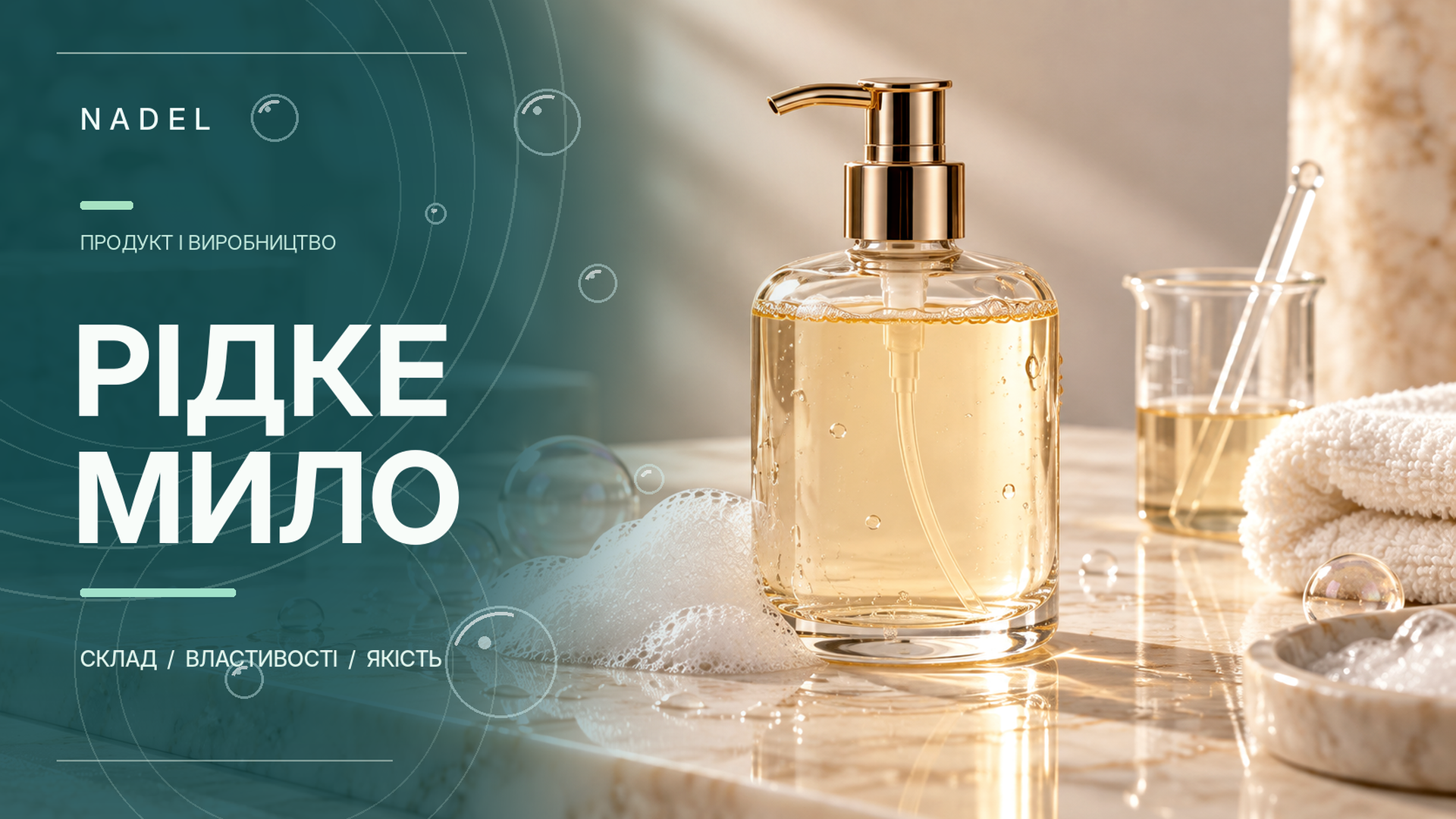
Liquid soap: composition, properties and manufacturing
Liquid soap is an everyday hand cleanser and a familiar part of personal hygiene. It is used repeatedly throughout the day: cleansing ingredients help remove dirt and excess sebum, while its liquid consistency allows convenient dispensing, even spreading over the skin and easy rinsing. A product used regularly needs to combine effective cleansing, convenience and skin comfort.
Modern liquid soaps offer a variety of textures and properties. A clear gel or gentle creamy consistency, light or denser foam, a fresh citrus or soft floral fragrance: each feature affects the experience of using the product. A balanced formulation, pleasant sensory properties and a suitable dispenser help create a cleanser that meets everyday care needs and leaves a pleasant impression after washing.
For cosmetics brands and companies expanding their personal hygiene ranges, liquid soap is a versatile product category. It can stand alone, form part of a hand care collection or complement a broader cosmetics range. Its quality depends not only on cleansing ability, but also on formulation balance, foam properties, skin comfort after use, product stability and packaging that suits its characteristics.
Liquid soap in daily care and public spaces
Hand cleansing is an integral part of everyday hygiene. Liquid soap provides a convenient way to wash regularly, combining effective dirt removal with controlled dispensing.
For home use, cleansing performance, pleasant consistency, easy rinsing and the feel of the skin afterwards are particularly important. Products intended for frequent use need a cleansing system that considers the skin barrier and balances effective cleaning with formula mildness.
In hotels, restaurants, offices and public facilities, liquid soap also contributes to an organised hygiene environment. Dispenser bottles make it possible to dispense the required amount without directly touching the main volume of product.
For hotels, spas and beauty salons, presentation matters alongside functionality. Fragrance, colour, bottle shape and label design can complement the establishment's overall concept. Some projects involve bespoke cosmetic ranges presented in the customer's visual identity.
Liquid soap therefore combines a practical hygiene function with opportunities to tailor the consumer experience. Formulations can be developed both for everyday use and for specialised cosmetics collections.
Liquid soap formats: texture, fragrance and application
Liquid soaps can differ in consistency, cleansing base, fragrance characteristics and dispensing method. These features influence how the product is perceived, its convenience and its manufacturing requirements.
Conventional liquid soap. This common format has a fluid or gel-like consistency and is intended for ordinary dispensers. Viscosity is adjusted so that it dispenses easily, spreads evenly over the skin and is convenient to use.
Cream-textured soap. These products may have a thicker, richer consistency and contain additional ingredients that improve the formula's sensory characteristics. Their composition depends on the desired result and ingredient compatibility.
Liquid soap for foaming dispensers. In this format, foam forms as the liquid passes through a special dispenser mechanism. Such systems generally need a formulation with suitable viscosity and foaming properties.
Fragranced liquid soap. Here, the fragrance composition is an important part of the consumer experience. It can complement the character of a cosmetics range, working with the bottle design and the brand's other products.
Liquid soap without added fragrance. This format contains no fragrance compound. However, fragrance-free does not necessarily mean completely odourless, because individual ingredients in the cleansing base may have an odour of their own.
For consumers, these differences shape convenience and the experience of using the soap. For manufacturers, they determine formulation, process parameters, dispenser selection and finished-product control requirements.
How liquid soap works: the skin-cleansing mechanism
The cleansing action of liquid soap relies primarily on the properties of surface-active agents, or surfactants.
Surfactant molecules have two functional parts: a hydrophilic part that interacts with water and a lipophilic part with an affinity for fats and other non-polar substances.
During washing, surfactants lower the surface tension of water, improve wetting of the skin and help detach dirt. Some oily impurities become incorporated into micellar structures formed by surfactant molecules and are then removed during rinsing.
This helps remove sebum, dust, cosmetic residues and other everyday impurities from the skin.
Cleansing performance depends on several factors:
- Surfactant type and concentration. These determine the formulation's main cleansing characteristics.
- The combination of surfactants. This affects foaming, formula mildness and interaction with the skin.
- pH. This is an important formulation parameter considered when assessing its properties.
- Washing time and technique. These affect the effectiveness of mechanical dirt removal.
- Rinsing quality. This determines how thoroughly cleanser and impurities are removed from the skin surface.
Foam accompanies cleansing, but its quantity alone is not a direct measure of cleansing effectiveness. Two formulations can produce different foam volumes and structures while both cleaning the skin adequately.
How the product behaves after contact with water also matters: how easily it spreads, how readily it rinses away and how the skin feels afterwards.
Liquid soap formulation: the role of each ingredient
Modern liquid soap is a multicomponent system in which each ingredient has a defined function. Finished-product quality depends on the cleansing base, supporting ingredients and their interactions.
The cleansing base: combining surfactants
In the cosmetics industry, products sold as liquid soap may use different types of cleansing systems.
Traditional soap is produced by saponifying fats with alkalis or neutralising fatty acids, and contains fatty acid salts. Many modern liquid hand cleansers instead use synthetic surfactants. These systems are known as syndets, short for synthetic detergents.
These approaches differ in composition, pH, foaming behaviour and interaction with the skin.
Syndet formulations may use several surfactant groups:
Anionic surfactants. These provide the main cleansing action and promote foam formation. A common example is Sodium Laureth Sulfate.
Amphoteric surfactants. These are combined with other surfactants to adjust cleansing-system characteristics. Cocamidopropyl Betaine is one example.
Non-ionic surfactants. Depending on their chemical structure, these may provide cleansing, supporting or solubilising functions. They help achieve the required formulation characteristics.
Combining several surfactant types makes it possible to adjust cleansing performance, foaming, viscosity and other product properties.
Liquid soap's mildness is determined by the whole formulation, rather than the presence or absence of a single ingredient: the surfactant types, concentrations, proportions and supporting ingredients all matter.
Moisturising and skin-conditioning ingredients
Liquid soap may contain additional ingredients intended to improve sensory properties and skin comfort after cleansing.
These include humectants, emollients and selected functional additives.
For example, glycerin (Glycerin) is a hygroscopic ingredient that can retain moisture. It is used in many cosmetics, including cleansing formulations.
Other ingredients compatible with the selected surfactant system may also be used to adjust the feel of the skin after washing.
It is important to consider that this is a rinse-off product: soap remains on the skin for a relatively short time before being removed with water. The presence of a moisturising or softening ingredient therefore does not automatically demonstrate a substantial skin-care benefit.
The finished formula's actual characteristics are assessed using its composition, intended use and relevant test results.
Viscosity, pH and foam properties
Liquid soap's consistency affects dispensing, spreading over the skin and compatibility with the packaging.
Specialised thickeners, rheology modifiers and electrolytes can be used to regulate viscosity. In some surfactant systems, sodium chloride is added for this purpose, but its effect depends on the formulation and concentration.
Increasing the amount of a thickening ingredient does not always produce a steady increase in viscosity. In some systems, beyond a particular proportion, viscosity may instead decrease.
The finished product's pH is a separate parameter.
Its suitable value depends on the cleansing system. Traditional soap formulations are generally alkaline, while syndet systems allow pH values closer to the naturally acidic conditions of the skin surface.
However, pH cannot be the sole criterion for assessing mildness or soap quality. The complete formulation and its interaction with the skin must be considered.
Foam properties also depend on the surfactant combination, concentrations, supporting ingredients and water characteristics.
Development defines the desired foam volume, density, stability and ease of rinsing.
Fragrance composition: the product's individual character
Fragrance is an important part of how consumers experience liquid soap. It complements the sensation of washing and can give a cosmetics range a recognisable character.
A wide range of fragrance families is used in liquid soap.
Liquid soap fragrances often combine familiar scent accents. Lemon, orange and lime create a citrus character, while green tea, mint and cucumber provide fresh, green nuances. Floral compositions may include lavender, rose and chamomile accords, and fruity ones apple, peach and raspberry. Vanilla, coconut and almond are typical of soft, sweet compositions.
The fragrance is selected with product positioning, the target audience and compatibility with the cleansing base in mind.
Fragrance ingredients can affect clarity, viscosity, colour and stability. Even after a scent is approved, its behaviour in the finished soap must therefore be checked.
International Fragrance Association (IFRA) Standards are also considered for fragrance compounds. As a rinse-off cosmetic product, liquid soap falls within IFRA Category 9.
The fragrance's compliance with the relevant restrictions is checked for the intended application and its concentration in the finished formulation.
Preservation system and formulation stability
Most modern liquid soap formulations contain a substantial amount of water. Ensuring microbiological stability is therefore an important part of development.
Preservatives and other ingredients may be used to help prevent unwanted microbial growth during storage and use.
The preservation system's effectiveness depends on formulation, pH, ingredient compatibility, packaging characteristics and manufacturing conditions.
Suitable microbiological methods are used to assess a cosmetic product's antimicrobial protection. These include preservative efficacy testing under ISO 11930 when indicated by the risk assessment.
Alongside microbiological stability, checks assess whether physical and sensory properties are maintained throughout the specified shelf life: uniformity, colour, fragrance, viscosity and other characteristics.
Bottle, dispenser and packaging: parts of the finished product
Liquid soap packaging serves several functions: storing the product, protecting it from external influences, enabling convenient dispensing and shaping the brand's visual identity.
The most common format is a plastic bottle with a pump dispenser. Different volumes, shapes and materials may be used according to the intended application.
Containers made from polyethylene terephthalate (PET) and high-density polyethylene (HDPE) are among those used for cosmetic cleansers. Material choice depends on the formulation, packaging construction and required finished-product characteristics.
The dispenser is an important component. Its design must suit the product's viscosity and deliver it correctly.
For example, the consistency of a formula intended for an ordinary pump may differ from that of a product designed for a foaming mechanism.
Packaging selection considers:
- Material compatibility with the formulation. Soap ingredients should not cause unwanted changes to the container or dispensing mechanism.
- Dispensing convenience. The quantity delivered per press should suit the product's consistency and intended use.
- Seal integrity. The packaging must allow the product to be stored and transported appropriately.
- Presentation. Bottle shape, colour, labelling and decorative elements should reflect the brand concept.
- Manufacturing compatibility. The container design must suit the available filling, closing and labelling processes.
Refill packs for suitable bottles are another possible format. They can expand the range and offer consumers an alternative way to buy a familiar product.
The formulation, dispensing system and packaging should consequently be treated as interconnected parts of the finished product.
Liquid soap quality: which characteristics are checked?
Liquid soap quality control covers physicochemical, microbiological, sensory and functional characteristics.
Compliance with the requirements is assessed during formulation development and sample approval, as well as after manufacture.
The main areas of control are:
Appearance and uniformity. Checks cover colour, clarity or the intended opacity, and the absence of unwanted sediment, separation or other changes.
pH. This is checked against the limits established for the particular formulation.
Viscosity. Product consistency and its stability are assessed under defined measurement conditions.
Cleansing and foaming properties. Checks assess cleansing ability, foam characteristics and ease of rinsing.
Sensory characteristics. Assessment covers fragrance, consistency and the feel during use and after cleansing.
Microbiological parameters. Checks assess compliance with microbiological quality requirements and, where necessary, the effectiveness of the preservation system.
Packaging compatibility. Testing examines possible changes to the formulation, container and dispensing mechanism during storage.
The choice of methods and acceptance criteria depends on product type, formulation and finished-product requirements.
Why viscosity stability needs to be tested
Viscosity is an important liquid soap parameter because it determines both the product's appearance and dispenser performance.
Consistency can change with temperature, fragrance composition, electrolyte concentration and the characteristics of the cleansing system.
For example, a formula may have the required viscosity immediately after manufacture but change during storage. This can affect dispensing convenience and product appearance.
Samples are compared under equivalent measurement conditions, including the specified temperature and viscosity measurement method.
Stability assessment helps identify when adjustments are needed and supports reproducible characteristics in subsequent manufacturing.
Cleansing performance and skin comfort after use
Effective cleansing is liquid soap's main function, but product quality extends beyond removing dirt.
For everyday products, spreading, foaming, rinsing and the feel of the skin after washing also matter.
Formulation development must consider that surfactants can interact with components of the skin's natural lipid layer as well as with impurities.
The cleansing system is therefore selected to provide the required cleaning performance and desired mildness characteristics.
Supporting ingredients may affect sensory perception, but substantiated conclusions about benefits require assessment of the finished formulation.
Contract manufacturing of liquid soap: from concept to commercial production
Contract manufacturing allows entrepreneurs and companies to create liquid soap under their own brand using a specialist manufacturer's technical, laboratory and production capabilities.
Cooperation follows a sequence of product development stages: concept and formulation, sample approval, packaging selection, manufacture of a production batch and preparation for sale.
Product concept and technical brief
The first step is to define the main characteristics of the future liquid soap.
The customer sets out the product requirements, including:
- Intended use and target audience.
- Preferred type and characteristics of the cleansing base.
- Consistency, colour and fragrance.
- Preferences for skin-conditioning ingredients.
- Packaging format and volume.
- Dispenser type and presentation.
- Planned production quantity.
- Target manufacturing cost of the finished product.
- Sales countries and channels.
At the outset, defining the concept, intended use and expected characteristics is sufficient. A finished formulation or finally approved design is not essential.
For the mass retail market, priorities might include a convenient format, balanced manufacturing costs and reproducible batches. For a hotel or professional range, they might be a bespoke fragrance, branded presentation and specified packaging parameters.
This information forms the basis of the technical brief for further development.
Formulation development and laboratory samples
Once the concept is agreed, the surfactant system, supporting ingredients, fragrance composition and required functional additives are selected.
Laboratory development establishes ingredient proportions, assesses compatibility, and adjusts pH, viscosity and foaming characteristics.
Samples allow appearance, fragrance, consistency, cleansing performance and the after-use feel to be assessed.
The formulation can be adjusted following testing until it meets the characteristics specified in the technical brief.
Containers and dispensers are selected in parallel so that the finished product can be evaluated in the agreed packaging format.
Sample approval and production specification
Once development is complete, the customer approves the final liquid soap sample.
This establishes the formulation, sensory and physicochemical characteristics, packaging parameters, fill volume and other finished-product requirements.
These parameters form the basis of the production specification and subsequent quality control.
The approved sample also supports reproducible characteristics in repeat production batches.
Manufacturing, filling and batch control
Preparation for commercial production begins once the formulation and packaging components have been approved.
The process may include preparing water and raw materials, measuring ingredients, mixing them in a defined sequence, adjusting physicochemical parameters and checking the finished bulk product.
Mixing requirements depend on the formulation. For cleansing systems, ingredient addition conditions, temperature and mixing intensity matter because they affect uniformity and foam formation during manufacture.
After the required checks, liquid soap is filled into the agreed containers, fitted with dispensers or caps, labelled and packed.
Consistency between batches is especially important. It is achieved by following the approved formulation, process parameters and established quality control procedures.
Order quantities and liquid soap manufacturing costs
When planning contract manufacturing, the mass of a production batch must be distinguished from the number of finished saleable units.
Production quantity may be specified in kilograms, while finished products are counted as filled units. Calculating the number of units requires the mixture's mass and density, fill volume and process losses during filling.
For liquid soap, NADEL specifies a minimum order range of 100–300 kg depending on the project. Manufacturing terms, finished-product quantity and components are agreed individually.
Liquid soap's manufacturing cost comprises several main elements:
- Surfactants and supporting ingredients.
- Moisturising and functional additives.
- Fragrance composition and colourants.
- Preservation-system ingredients.
- Bottle, cap or dispenser.
- Labels, printing and decorative finishing.
- Individual and transport packaging.
- Production operations, filling and assembly.
The final cost depends on formulation complexity, raw material selection, production volume, packaging type and additional customer requirements.
Commercial planning should consider the total cost of a complete product ready for sale. This helps define the project budget, price positioning and economics of the future range more accurately.
Liquid soap manufactured by NADEL has a shelf life of 12–24 months. The specific period is established for each product individually, considering its formulation, packaging, stability assessment and defined storage conditions.
Safety, labelling and supporting documentation
Liquid soap intended to cleanse human skin is a cosmetic product. Requirements for safety, composition, labelling and documentation depend on intended use and the applicable rules of the target market.
Ukraine's Technical Regulation on Cosmetic Products sets requirements for safety, assessment, accompanying information and placing products on the market. Product preparation takes account of the current regulation and its transitional provisions.
Cosmetic documentation may include a Product Information File (PIF), a Cosmetic Product Safety Report (CPSR), formulation data, relevant test results and documents required for labelling and notification under the applicable requirements.
For fragranced liquid soap, the fragrance compound's compliance with restrictions for use in rinse-off cosmetics is also considered.
Particular attention is given to substantiating claimed properties. For example, specific antibacterial, hypoallergenic or other special claims require appropriate evidence and may affect the regulatory requirements applicable to the product.
Documentation should be addressed during formulation development so that composition, packaging, labelling and future sales conditions can be agreed in advance.
From a first formulation to your own cosmetics range
Liquid soap can be a standalone branded product or the starting point for a broader range of personal hygiene and skin-care products.
A range may include several fragrance variants with a shared presentation concept. Citrus, floral and woody compositions, for example, can use matching bottles and a common design, naming and packaging system.
Another direction is to create a coordinated hand care collection.
Liquid soap can be paired with hand cream or lotion using a shared fragrance profile and visual concept. The products have different functions but together form a coherent everyday range.
Technical requirements differ between formats. A liquid soap cleansing formulation and a cream emulsion each require their own ingredient selection, stability work and relevant testing.
Refill packaging for compatible bottles can be another useful addition. Its development needs to consider product storage, dispensing and microbiological protection.
NADEL's production range includes liquid soap, hand creams and lotions, shower gels, shampoos and other cosmetics. This creates opportunities to develop individual products or coordinated ranges under a customer's own brand.
NADEL: own-brand liquid soap contract manufacturing
NADEL is a Ukrainian manufacturer of perfume, cosmetics and fragrance products, specialising in contract manufacturing for brands, entrepreneurs, distributors and corporate customers.
The company takes a comprehensive approach to manufacturing projects. Cooperation may include formulation development, raw material selection, laboratory samples, container and dispenser selection, filling, packaging and preparation of the required documentation.
NADEL's own production and laboratory capabilities support liquid soap development around the desired cleansing and sensory characteristics, fragrance profile, packaging and commercial requirements.
To begin a project, define the main parameters of the future product: intended use, desired consistency, fragrance, packaging format, planned production quantity, target manufacturing cost and sales market.
A completed formulation or finally approved design is not required at the initial stage. These can be developed and agreed during cooperation with the manufacturer.
To discuss liquid soap contract manufacturing under your own brand, complete the brief on NADEL's official website. The information provided will help the team identify possible formulation solutions, components and project-specific terms.