
Scented candles: ingredients, properties and manufacturing
Scented candles bring together the properties of wax, fragrance, wick and container. Explore their ingredients, burning principles, component selection, manufacturing stages, quality control and options for own-brand contract manufacturing.
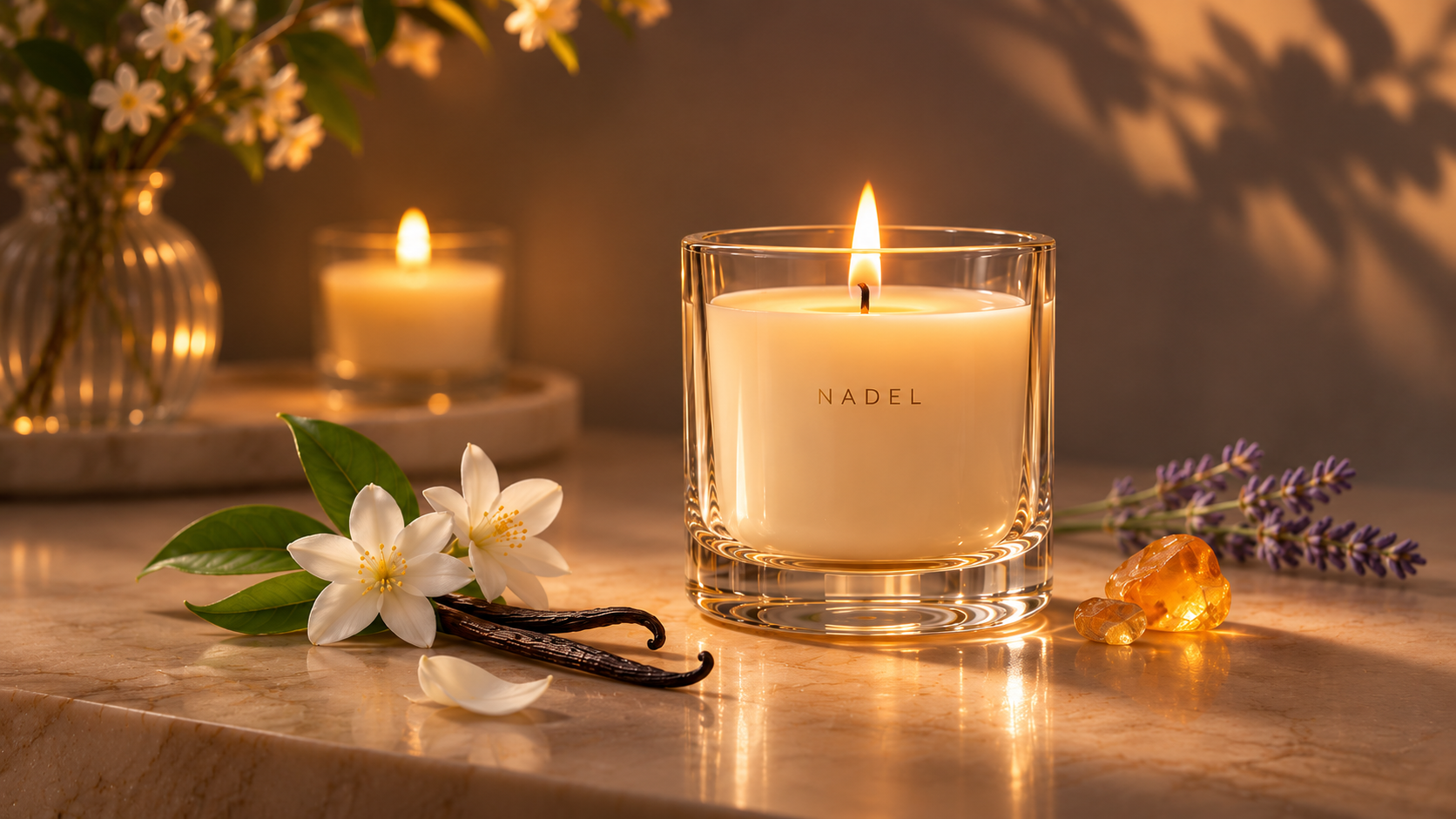
Scented candles: ingredients, use and manufacturing
Scented candles combine decorative lighting with room fragrance. As a candle burns, its flame creates soft light while the heated wax gradually releases fragrance components. With their variety of scents, shapes and finishes, candles are used in homes, hotels and spas, as well as in gift and fragrance collections.
A scented candle's character depends on more than its fragrance. Wax type, fragrance composition, wick construction, container shape and burning behaviour all matter. Together, these elements affect scent intensity, usable burn time, appearance and the finished product's consistent performance.
Creating a quality candle requires its fragrance, physicochemical and manufacturing characteristics to work together. Behind the finished product are wax selection, fragrance-profile development, wick trials, pouring parameters, burn testing and packaging choices. This allows brands to develop individual signature scents or complete own-brand candle collections.
Scented candles in interiors: function and aesthetics
A scented candle is experienced through fragrance, light and presentation at the same time. Even unlit, it can be a decorative element; in use, the flame's warm light adds to the fragrance experience.
At home, candles are used in living rooms, bedrooms, bathrooms and other spaces where they can be positioned safely. Fragrance choice depends on personal preference, the character of the space and the desired scent intensity.
Fresh citrus and green compositions are often associated with lightness, floral scents with softness and refinement, while woody, amber and spicy fragrances create a warmer, richer impression. A single composition may combine several directions to establish its own recognisable character.
In hotels, beauty salons and spas, scented candles can complement an interior concept and a range of branded products. They are also used in gift sets, corporate collections and seasonal offers.
For a brand, a candle brings fragrance, appearance and user experience together in a single concept. This provides scope to work with different scent families as well as container design, wax colour, gift packaging and the collection's overall style.
Scented candle formats: from glass containers to decorative shapes
Scented candles can differ in construction, size, number of wicks and intended use. Each format has its own formulation and manufacturing requirements.
Candles in glass containers are among the most common home-fragrance formats. The wax is poured directly into the container in which the candle will be used. This allows fragrance to be combined with different glass finishes, labels and lids.
Candles in ceramic and metal containers can form part of decorative or gift collections. Checking material heat resistance, container construction and actual heating during burning is particularly important for these products.
Moulded candles are made in specialised moulds that create different geometric and decorative shapes. They require a wax base capable of retaining the intended shape and a suitably selected wick.
Compact candles and tealights are used as individual products or components of sets. Their small size affects wax quantity, burn time and construction requirements.
Multiple-wick candles form a separate category. They are used mainly in wider products where an appropriate distribution of heat and wax melting pattern is required.
Format selection determines more than appearance. Candle geometry, container material and wick count directly affect burning, so these parameters are considered during product development.
How a scented candle works: wax, flame and wick
A candle works through a combination of wax melting, capillary transport of liquid fuel and combustion.
Once the wick is lit, heat from the flame melts the surrounding wax. This liquid travels upwards through the wick's capillary structure, heats up and vaporises. Vapours of the combustible components sustain the flame, while the heat released continues to melt the wax.
In a scented candle, the wax base also contains a fragrance composition. During heating, its volatile components gradually enter the air, spreading fragrance through the room.
The intensity of this process depends on the molten wax temperature, its surface area, the fragrance composition and the wick's burning behaviour.
An incorrectly selected wick may cause uneven melting, an excessively large flame or a build-up of unmelted wax around the container walls. The wax blend, container diameter and fragrance concentration also affect the result.
Good burning performance therefore comes from a coordinated system, rather than from choosing a particular wax or wick alone.
Scented candle ingredients: the main components and their functions
A conventional scented candle consists of a wax base, fragrance composition and wick. Depending on the product concept, it may also include dyes and additional functional ingredients.
Different ingredients affect more than appearance or fragrance. They can change the melting temperature, wax structure, consumption rate and flame characteristics.
The wax base: soy, coconut, paraffin and other waxes
Wax is the foundation of a scented candle. It forms the product's structure, holds the fragrance composition and supplies fuel to the flame during use.
Modern manufacturing uses waxes of different origins alongside specially developed blends.
Soy wax is obtained from plant raw materials based on soybean oil. It is used for scented container candles and various wax compositions. It can produce a soft texture and a characteristic surface whose properties depend on the particular wax grade, formulation and cooling conditions.
Coconut wax is made from coconut oil components. In candle formulations, it is often combined with other waxes to achieve the required consistency, melting temperature and fragrance characteristics.
Paraffin wax is widely used in candle manufacturing. Its characteristics depend on the degree of refining, fractional composition and other raw material properties. Paraffin bases can be used for both container and moulded candles.
Beeswax has a natural yellowish colour and its own distinctive odour, which can affect the perception of an added fragrance. It is used alone or blended with other wax components.
Rapeseed, palm, stearin and other specialised wax bases are also used.
In practice, wax blends allow more precise adjustment of finished-candle properties. Combining several components can help regulate hardness, melting behaviour, appearance and fragrance compatibility.
Wax selection is not determined solely by origin. Melting temperature, fragrance-holding capacity, cooling behaviour, wick compatibility and finished-candle test results are important for manufacturing.
Fragrance composition: how a candle's scent is created
The fragrance composition, or fragrance compound, determines the candle's aromatic character. It may contain natural aromatic materials, synthetic fragrance substances or combinations of both.
Candles use compositions from different fragrance families: floral, woody, citrus, fruity, spicy, amber and others. These can be combined to create a more complex fragrance profile.
Floral compositions may reveal notes of jasmine, rose, peony, lavender or orange blossom. Woody scents often include sandalwood, cedar, vetiver and patchouli accords. Warm amber and spicy fragrances may combine vanilla, cardamom, cinnamon, musk and resinous nuances.
Compositions evoking coffee, baked goods, caramel, fruit and assorted sweet accords form another group. Their character comes from a combination of fragrance substances and does not necessarily require the corresponding food ingredients.
Candle manufacturing must assess not only a fragrance compound's initial smell but also how it performs in the wax base during use.
The same composition may develop differently in soy, paraffin or blended wax. Fragrance perception is influenced by component compatibility, temperature conditions, fragrance concentration and how the finished candle heats up.
Natural essential oils can also serve as fragrance raw materials, but their suitability for a particular candle formulation must be assessed separately. Natural origin alone does not determine fragrance quality, stability or finished-product safety.
Fragrance concentration and scent intensity
The fragrance concentration expresses its mass fraction in the wax blend. It is selected according to the properties of the wax and fragrance composition, and the intended character of the finished product.
Adding more fragrance does not necessarily produce a proportional increase in scent strength. Excessive concentration can adversely affect wax uniformity, burning behaviour and finished-product stability.
The raw material manufacturer may specify recommended fragrance loading limits for each wax base. Development also considers the properties of the particular fragrance and applicable conditions for its use.
The optimum concentration is established through testing. Assessment covers the unlit scent, intensity during burning, wax stability and wick performance.
The wick: how its construction affects burning
The wick is a key functional element of a candle. It carries molten wax to the combustion zone and influences flame size, wax consumption rate and melting behaviour.
Manufacturing uses wicks of different constructions. Cotton and wooden wicks are the most common options.
Cotton wicks can differ in braid structure, thickness and specialised treatment for their intended use. They are selected according to wax type, candle diameter and fragrance characteristics.
Wooden wicks differ in construction and burning behaviour. Some may produce a gentle crackle, adding another element to the candle experience. Their stability and compatibility with the wax base must nevertheless be checked.
Wick size is chosen through practical testing. Insufficient heat output may cause incomplete wax melting, while excessive output can enlarge the flame, accelerate wax consumption and cause unwanted container heating.
Wider candles may use several wicks. Their positions and number are determined by product geometry and test results.
One wick type is not suitable for every candle. Even with the same container dimensions, changing the wax base or fragrance composition may require a different solution.
Dyes and supporting ingredients
Wax colour can form part of a scented candle's design concept. Specialised dyes suitable for the relevant wax systems are used for this purpose.
Dye selection depends on the desired shade, wax transparency or opacity, colour stability and effects on burning.
The formulation may also contain functional additives that help regulate wax hardness, crystallisation behaviour or other processing properties.
Decorative elements require particular attention. Materials that can ignite or enter the flame zone may create additional risks. Dried plants, wooden pieces and other decorations within the wax itself must therefore be assessed in relation to the finished product's fire safety.
Development considers the compatibility of all additives with the wax, fragrance and candle construction.
Containers and packaging: function and visual identity
A scented candle container has both decorative and functional roles. It shapes the product's appearance and must suit the heating conditions encountered during use.
Container candles use glass, ceramic, metal and other materials whose suitability is confirmed by appropriate testing.
Glass containers offer different design options: clear, frosted, tinted or decoratively finished surfaces. Glass properties, wall geometry, container stability and behaviour under heat are important for candles.
Ceramic containers can have different shapes, textures and coatings. Selection assesses heat resistance, structural stability and compatibility with the wax-pouring process.
Metal containers are used for compact, travel and gift formats. Their construction must also suit heating behaviour and the intended method of use.
Additional elements may include a lid, label, decorative finish and individual box. A lid helps protect an unlit candle's surface from dust and can complement the design, but its use during burning depends on the product's construction and instructions.
Consistent presentation matters to a brand. Container shape, wax colour, fragrance and packaging should follow a shared concept while maintaining the product's required functional characteristics.
Scent intensity: fragrance before and during burning
A candle's fragrance properties are assessed in two main states: before lighting and during burning. The industry terms for these are cold throw and hot throw.
Cold throw is the fragrance of an unlit candle. It describes the scent impression of the finished product under normal conditions while the wax remains solid. This property is particularly apparent when discovering the product in a shop or opening its packaging.
Hot throw is the fragrance during burning. It describes the intensity and character of scent diffusion once the wax heats up and a molten surface forms.
Both characteristics depend on the fragrance composition, wax-base properties, fragrance concentration and candle construction.
A strong unlit scent does not necessarily mean equally strong fragrance during burning. Some compositions have a pronounced initial smell but become more restrained when heated. Others develop more fully during use.
Finished-product assessment should consider scent strength and whether the fragrance profile matches the original concept. The composition should retain its intended character, with an intensity appropriate to the product's purpose.
Laboratory testing may compare several concentrations, wax bases and wicks, assessing fragrance perception under comparable conditions.
Scented candle quality: what is checked?
Scented candle quality control covers not only appearance and fragrance but also the finished product's behaviour throughout its entire burn life.
Testing considers the actual combination of wax base, fragrance, wick, dyes and container. Replacing any of these elements can change candle characteristics, so individual formulation changes require reassessment.
The main areas of control include:
- Wax appearance. Uniformity, colour, surface condition and absence of unwanted defects.
- Fragrance stability. Retention of scent and absence of unwanted liquid components separating onto the wax surface.
- Wick position and performance. Correct placement, burning behaviour and flame stability.
- Melt-pool formation. Wax melting characteristics and evenness of consumption.
- Flame height. Compliance with established fire-safety criteria.
- Soot formation. Assessment of unwanted smoke and deposits from incomplete combustion.
- Container heating. The behaviour of materials and construction during use.
- Finished-product stability. The ability to remain safely in its intended position during use.
- Burn time. Operating duration under defined test conditions.
One possible defect is tunnelling: uneven melting that leaves a substantial amount of solid wax around the container walls. It can relate to an unsuitable wick, usage conditions or formulation characteristics.
Control also considers the opposite situation, where excessive heat output causes an unwanted increase in flame size or container temperature.
Testing should cover the candle's entire use cycle because its behaviour may change as the wax level falls and the flame approaches the bottom of the container.
Burn time and wax consumption rate
Burn time is a scented candle characteristic of interest to both consumers and manufacturers.
It is influenced by the wax blend's mass and composition, wick characteristics, container diameter and usage conditions.
Testing may determine wax consumption in grams per hour by recording changes in candle mass under defined conditions. Actual usable burn time is assessed from the complete test results.
It is important to distinguish the nominal wax fill mass from the total product mass, including container and packaging. These figures have different meanings when comparing candles.
Two candles with the same wax mass can have different burn times. This reflects differences in formulation, wick construction and product geometry.
A particular candle's burn time should therefore be determined by testing the finished product, rather than solely from its volume or wax type.
Storage and finished-candle stability
During storage, wax can respond to changes in temperature, light and other external factors. Some vegetable waxes undergo changes in crystalline structure, which may appear as light patches or surface changes.
Scented candle stability is also affected by fragrance–wax compatibility, fragrance concentration, dye properties and packaging.
Assessment checks retention of appearance, fragrance, wax uniformity and other parameters under the intended storage conditions.
A specific shelf life or recommended storage period is established for each product, taking account of formulation, packaging and test results.
How scented candles are made: the manufacturing process
Scented candle manufacturing involves preparing the wax base, adding the fragrance composition, forming the finished product and checking its characteristics.
Process parameters depend on wax type, fragrance composition, candle construction and the selected equipment. Melting temperatures, ingredient addition order and cooling conditions may differ between formulations.
Raw material preparation. The wax base, fragrance composition, wicks, dyes and other materials are checked before production. Controls follow approved specifications and finished-product requirements.
Wax melting. The wax base is heated to the temperature specified in the manufacturing instructions. Temperature conditions, mass uniformity and readiness for adding other ingredients are monitored throughout.
Adding the fragrance composition. Fragrance is introduced into the prepared wax under conditions that ensure proper distribution. Mixing temperature and duration are determined from the properties of the wax and the particular composition.
Preparing containers and wicks. Before pouring, container cleanliness and correct wick placement and fixing are checked. Centring the wick is particularly important for container candles.
Pouring the wax. The prepared blend is dispensed into the appropriate containers or moulds. Fill mass, pouring temperature and other process parameters are controlled at this stage.
Cooling and structure formation. After pouring, the wax gradually solidifies. Cooling conditions influence crystallisation, surface condition, adhesion to the container walls and the finished candle's appearance.
Finished-product stabilisation. Some wax systems require a resting period after manufacture. Whether this is necessary and how long it lasts depend on formulation properties and recommendations for the raw materials used.
Finishing. Surface condition, wick position, appearance and product mass are checked. Where needed, the specified finishing operations prepare the candle for packaging.
Control and packaging. After passing the required checks, products are labelled, assembled and packed in the agreed format.
The main aim of the manufacturing process is to reproduce the candle's fragrance, functional and visual characteristics consistently from batch to batch.
Scented candle safety, labelling and documentation
Scented candles combine combustible materials, fragrance ingredients and an open flame. Fire safety, composition assessment, correct labelling and supporting documentation are therefore important during development.
Fragrance compositions are assessed with reference to International Fragrance Association (IFRA) Standards, which establish conditions for the use of particular fragrance ingredients.
Under IFRA classification, scented candles belong to Category 12. Fragrance selection checks compliance with applicable standards and considers the composition's properties in the finished wax blend.
An IFRA Certificate provides information on a particular fragrance composition's compliance with IFRA Standards for the relevant application categories.
An SDS (Safety Data Sheet) provides information on fragrance raw material properties, handling, storage and safety measures.
An Allergen Declaration identifies relevant fragrance allergens considered during composition assessment and preparation of information for sales markets.
A Specification defines fragrance raw material characteristics, while a COA (Certificate of Analysis) may provide quality-control results for a particular batch.
Finished-candle assessment separately considers product safety, burning characteristics, container suitability and correct labelling.
Important European reference standards include EN 15493 for candle fire safety, EN 15494 for safety labelling and EN 15426 for sooting behaviour. Product preparation considers current editions of these documents and the requirements of the particular market.
For sale in the European Union, applicable GPSR, REACH and CLP provisions are also considered. Scented candle classification and labelling depend, among other things, on the properties and concentrations of substances in the finished mixture.
In Ukraine, hazard classification, labelling and handling of chemical products are governed by the relevant technical regulations, including those approved by Cabinet of Ministers Resolutions No. 539 and No. 847, taking account of current editions and transitional provisions.
Because scented candles are not cosmetics, their supporting documentation is prepared according to the requirements applicable to this product type.
Candle labelling must provide the necessary manufacturer, product and safe-use information. Depending on the market and finished-product characteristics, appropriate warnings, pictograms and other details may be required.
Basic usage rules include placing the candle on a stable, heat-resistant surface, keeping a safe distance from flammable materials, following the instructions and never leaving a lit candle unattended.
A comprehensive safety approach aligns formulation, candle construction, packaging and documentation before commercial production.
Own-brand scented candle contract manufacturing
Creating an own-brand scented candle involves several interconnected elements: fragrance, wax base, wick, container, design and manufacturing technology.
Scented candle contract manufacturing brings these processes together through cooperation with a specialist manufacturer. It covers concept development, material selection, sample production, testing, packaging approval and finished-product manufacture.
For a brand, this provides an opportunity to develop its own fragrance collection without organising a separate manufacturing operation for each new product.
Product concept and technical brief
The first stage of cooperation is defining the future candle's main characteristics.
The brief considers the desired fragrance direction, wax-base type, container format, colour, design, target audience, price positioning and planned production volume.
A retail collection may prioritise several scents in matching containers with recognisable design. A corporate order may focus on an individual fragrance, branded presentation and gift packaging.
At the outset, a general concept is sufficient. The final wax blend, wick type and process parameters are established during development and sample testing.
Wax selection, fragrance creation and laboratory samples
Once the concept is agreed, possible formulation solutions are identified.
A scented candle can use a composition selected from a professional fragrance library or a bespoke scent developed according to the technical brief.
In parallel, a wax base is chosen to suit the intended product construction and desired burning characteristics.
Laboratory samples allow comparison of several fragrance options, concentrations, wick types and manufacturing parameters.
Assessment considers candle appearance, scent when unlit and burning, wax melting behaviour, flame stability and container compatibility.
Test results may lead to adjustments in the formulation or component materials until the agreed characteristics are achieved.
Design, container and component materials
The future candle's visual concept is developed alongside its formulation.
This stage selects container shape, material and colour, decorative finish, label, lid and individual box.
A fragrance collection can use a shared design with different names and colour accents, bringing several compositions together in one range.
Container selection is aligned with technical requirements. It must suit the candle construction and pouring conditions, with suitability checked through burn testing.
Design and technical compatibility are considered together so that presentation supports the product concept and meets its functional requirements.
Sample approval and commercial production
When development is complete, the customer approves the final scented candle sample.
The sample establishes the formulation, wax characteristics, fragrance composition, wick type, container parameters, fill mass, design and quality requirements.
The approved information is used to prepare the production specification and manufacturing documentation.
The next steps organise purchasing of raw materials and components, wax-blend preparation, pouring, cooling, quality control and packaging.
Particular attention is given to reproducibility between batches, because brands need consistent fragrance, appearance and burning quality in repeat deliveries.
Production quantities and scented candle costs
Production planning defines the number of finished saleable units, wax-blend mass and target manufacturing cost.
Quantity calculations consider fill mass, the number of fragrances in the collection, container format and requirements for wicks and other components.
The main elements of a scented candle's manufacturing cost are:
- Wax base. Wax type, blend composition and the quantity of raw material required.
- Fragrance composition. Fragrance ingredients, concentration and purchase cost.
- Wick and fixing. Wick type, construction and associated components.
- Container. Glass, ceramic, metal or another agreed material.
- Decorative finish. Colouring, printing, labelling and additional design features.
- Individual packaging. Box, protective elements and gift presentation.
- Production processes. Wax preparation, pouring, cooling, quality control and assembly.
- Development and documentation. Work needed to approve the product and prepare it for sale.
Final cost is also affected by design complexity, material choice, number of fragrances, batch size and manufacturing-process requirements.
Commercial planning should assess the full cost of a complete scented candle, including its formulation, container, packaging and agreed production operations.
Minimum order quantity and specific contract manufacturing terms are established individually according to product construction, formulation, components and project parameters.
From a single fragrance to your own candle collection
Own-brand scented candle development can begin with a single composition that reflects the brand's character and becomes a recognisable part of its range.
The collection can later grow through fragrances with different characters. One range might combine a fresh citrus-green composition, a soft floral-musky scent and a richer woody-amber direction, for example.
A shared visual concept is especially important. Coordinated container design, naming, labels and individual boxes bring different fragrances together in a coherent collection.
Another development direction is seasonal fragrance series or gift sets. Corporate customers may be interested in candles with individual presentation and a composition that reflects their company's character.
A scented candle can also be part of a wider home-fragrance collection. A shared fragrance concept might unite a candle, reed diffuser and room spray, for example.
Each category nevertheless requires its own formulation adaptation. A candle's wax base, a diffuser's liquid system and a room spray formulation have different technical requirements, so fragrance compositions are assessed separately in each format.
This approach develops a brand's own fragrance identity across several products while maintaining the collection's shared character.
NADEL: own-brand scented candle contract manufacturing
NADEL is a Ukrainian manufacturer of perfume, cosmetics and fragrance products, specialising in contract manufacturing for brands, entrepreneurs, distributors and corporate customers.
Scented candles form part of the company's home-fragrance range alongside reed diffusers, room sprays and other scenting products.
NADEL combines perfumery, laboratory and manufacturing expertise to provide a comprehensive approach to own-brand product development.
Cooperation may cover concept development, fragrance selection or creation, choice of wax base and components, sample manufacture, design approval, commercial production and documentation support.
A complete scented candle contract manufacturing service combines fragrance creation, manufacturing processes and finished-product presentation within a single project.
To begin cooperation, define your preferred fragrance direction, candle format, container material and appearance, approximate quantity, price positioning and sales market.
A finished formulation or finally approved design is not essential at the initial stage. These decisions can be developed and approved during product development.
To discuss creating your own scented candle or launching a collection under your brand, complete the brief on NADEL's official website. Based on your concept, the team will help identify possible fragrance, technical and design solutions, components and individual manufacturing terms.