
Body scrubs: how salt, bicarbonate and skin-care ingredients work together | NADEL
Salt and bicarbonate scrubs combine mechanical exfoliation with skin care. This article explores the properties of salt and bicarbonate and the role of softening ingredients. Discover how the required texture is created, the details of manufacturing technology and opportunities for own-brand cosmetic contract manufacturing.
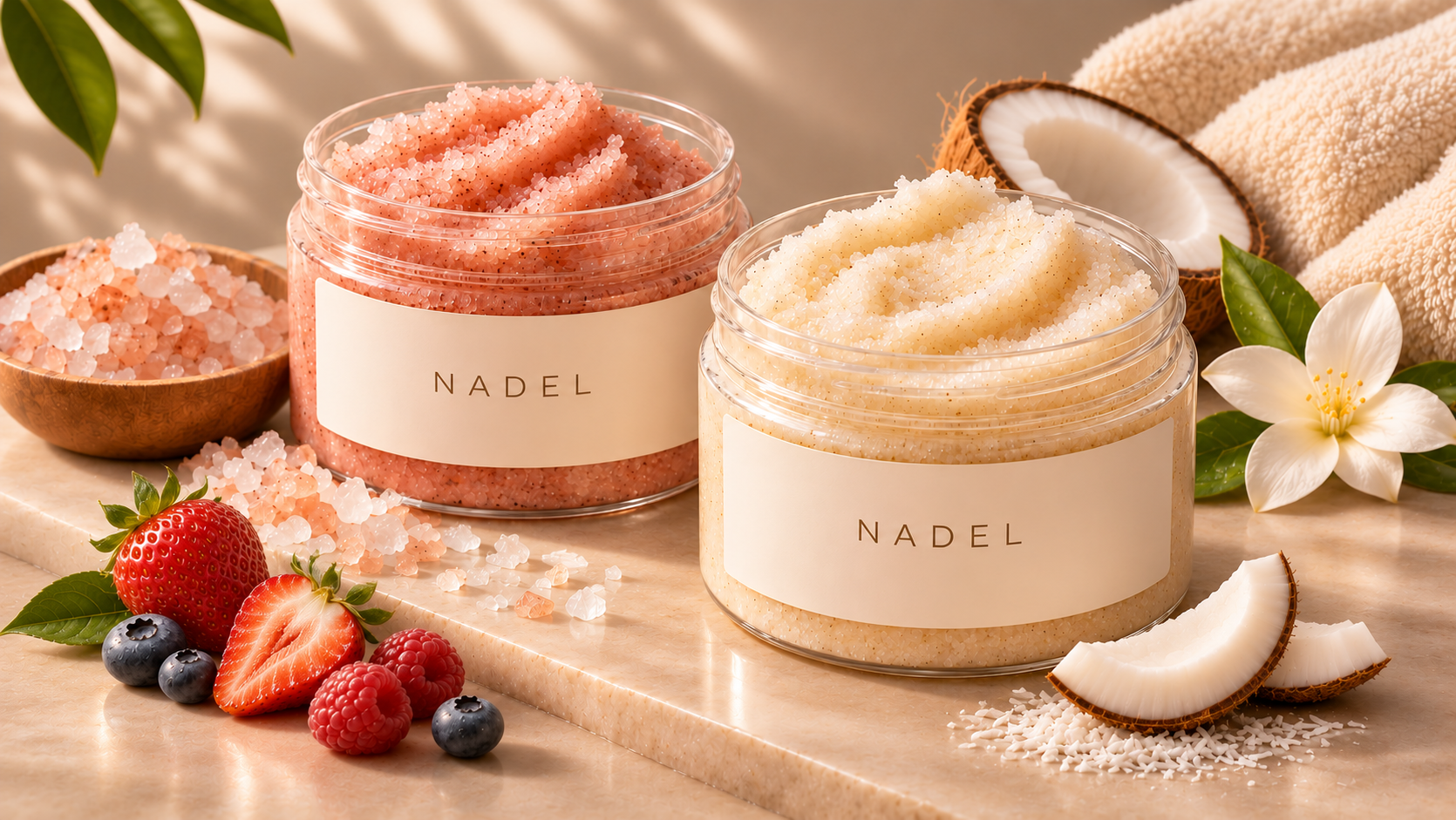
Body scrubs: exfoliation, skin care and manufacturing considerations
A body scrub is a cosmetic product combining mechanical removal of dead cells from the skin's surface with moisturising and softening properties. This combination can leave skin feeling smoother, softer and more pleasant to touch. A scrub characteristically combines exfoliating particles with a cosmetic base that supports comfortable application, even distribution and additional skin-care benefits.
Salt and bicarbonate scrubs hold a particular place among popular body-care products. They differ in the properties of their main exfoliating ingredients, texture and sensations during use. Salt crystals provide a distinctly granular structure, while fine bicarbonate particles allow a different type of mechanical exfoliation. With appropriately selected skin-care ingredients, both formats can provide comfortable cleansing and a pleasant skin feel after rinsing.
Behind a finished scrub is a carefully developed formula. Particle size and concentration, cosmetic base composition, fragrance, consistency and packaging determine the product's properties. For cosmetic brands, this offers opportunities to create individual body-care products or complete collections with distinctive textures, scents and presentation.
Body scrubs in everyday skin care
The skin's surface continually renews itself. During natural exfoliation, cells of the epidermis's outer layer gradually detach. Individual characteristics, environmental conditions and skin-care habits influence the skin's condition and appearance.
A scrub complements natural exfoliation through the mechanical action of small particles. With gentle massage movements, they contact the skin's surface and help remove some dead cells. Skin may feel smoother and more even to touch afterwards.
The cosmetic base is important for comfortable use. It helps distribute exfoliating particles over the skin, provides the required slip and influences the sensation during massage.
In home care, scrubs are often used on the arms, legs and other body areas needing additional exfoliation. Separate formulations may be developed for professional use in beauty salons and spas.
Exfoliation intensity must suit the skin's characteristics. Different particles and textures create different sensations, so scrub selection depends on the product's intended purpose and the desired type of care.
How mechanical exfoliation works
A scrub's main action comes from physical contact between exfoliating particles and the skin's surface. During application, they move with the cosmetic base to provide mechanical exfoliation.
Particle size, shape, hardness and concentration influence this process. Smaller, more rounded particles can feel gentler, while larger or irregular particles can produce a stronger mechanical action.
The cosmetic base also plays an important role. Oils, emollients, glycerin and other ingredients help create the required texture, improve spreading and determine how the product interacts with the skin.
For salt and bicarbonate scrubs, the exfoliating ingredients' behaviour on contact with water is another factor. Both salt and bicarbonate are water-soluble, but differ in dissolution rate, particle size and physicochemical properties.
A scrub's texture can gradually change during use. The amount of water, massage duration, base composition and particle properties influence this process.
The effectiveness and comfort of mechanical exfoliation therefore depend on the whole formulation, not just the choice of salt or bicarbonate.
Salt and bicarbonate scrubs: two different formats
Salt and bicarbonate scrubs share a purpose but differ in their exfoliating particles and approaches to building cosmetic texture.
A salt scrub contains salt crystals that create its characteristic granular structure. Their size and concentration are chosen for the intended exfoliation intensity. Combined with softening ingredients, the product can offer both mechanical cleansing and comfortable slip during application.
A bicarbonate scrub uses sodium bicarbonate, an ingredient that generally has finer particles. Depending on the formula, it may be combined with other exfoliating and skin-care ingredients to obtain the desired consistency and usage characteristics.
In both formats, the cosmetic base, fragrance composition and ingredient ratios play important roles. They determine the scrub's thickness, particle distribution, massage sensation and skin feel after rinsing.
For consumers, these features create an individual usage experience. For manufacturers, they form the basis of the technical brief used to develop and test the finished product.
Body-scrub ingredients: the main components and their functions
A salt or bicarbonate scrub may contain exfoliating ingredients, cosmetic oils, plant butters, glycerin, emollients, texturisers, fragrance compositions and other functional ingredients.
The specific composition depends on the product's purpose, desired consistency, exfoliation intensity and after-feel. Each ingredient has its own role, and their combination determines the finished formula's properties.
Salt as an exfoliating ingredient
Salt (Sodium Chloride) is a common mineral ingredient used for mechanical skin exfoliation.
Salt crystals create a scrub's granular structure and contact the skin during massage. Their characteristics depend on the raw material's origin, processing and particle-size grading.
Cosmetic formulas can use salt of different particle sizes. The grading affects exfoliation intensity, spreading behaviour and sensations during application.
Crystal shape also matters. Particles of the same size can have different geometries and produce different sensations on contact with skin.
Salt dissolves readily in water, so its particles gradually change during use. The speed depends on the amount of moisture, crystal size and application conditions.
Developing a salt scrub considers both salt properties and its ratio to the cosmetic base. An appropriate texture distributes particles evenly and provides the intended type of mechanical exfoliation.
Bicarbonate: sodium bicarbonate in a cosmetic formula
Sodium Bicarbonate is a finely divided mineral ingredient that can be used in cosmetic scrubs to provide mechanical exfoliation.
Its particles generally differ in size and shape from salt crystals. Bicarbonate scrubs can therefore have different textures, spreading behaviour and sensations during application.
In cosmetic formulas, bicarbonate can be combined with glycerin, texturisers and other functional ingredients. Some formulas also include sugar or other particles to create the intended finished-product properties.
Sodium bicarbonate has particular physicochemical characteristics. In particular, dissolving it in water produces a mildly alkaline environment. Developing a bicarbonate scrub therefore involves assessing ingredient concentration, conditions of use, compatibility and the safety of the finished formula.
A bicarbonate scrub's properties are not determined solely by the amount of sodium bicarbonate. Overall formula structure, supporting ingredients and test results are important for a comfortable cosmetic product.
Cosmetic oils, butters and emollients
Skin-care ingredients complement mechanical exfoliation and influence a scrub's tactile properties. They help build consistency, provide the required slip and support skin softening after use.
Formulas may use sunflower, coconut, almond, avocado and other cosmetic oils. Selection considers their composition, sensory properties and stability.
Shea butter (Butyrospermum Parkii Butter) can give the base a richer consistency and complement its softening properties. Other plant butters and lipid ingredients may be used, depending on the formula.
Emollients help improve slip and create a comfortable skin feel. This group includes various cosmetic oils, esters, hydrocarbons and other ingredients with suitable properties.
For example, Petrolatum and Paraffinum Liquidum can be used in skin-care cosmetics to soften skin and form a layer that helps reduce moisture loss.
Some salt scrubs leave skin feeling soft and smooth after rinsing because a portion of the skin-care ingredients may remain on the surface. The strength of this effect depends on the specific product's composition.
Softening ingredients therefore affect both scrub consistency and the overall character of the care it provides.
Glycerin and other functional ingredients
Glycerin is a common cosmetic ingredient with hygroscopic properties. It helps retain water and can be used to establish the cosmetic base's required characteristics.
In bicarbonate scrubs, glycerin may form part of the texturing system, influencing consistency and the distribution of exfoliating particles.
Texturising, solubilising and conditioning ingredients may also be used to create a stable cosmetic mixture. They are selected according to the main ingredients' properties and the intended product characteristics.
Some formulas may include panthenol, vitamin E derivatives and other skin-care ingredients.
Panthenol is used in cosmetics for its moisturising properties and its ability to complement formulas designed for skin comfort.
Tocopherol derivatives may provide skin-care or antioxidant functions, depending on the specific substance and its role in the formula.
Each of these ingredients is assessed within the whole formulation. The combination of exfoliating and skin-care ingredients shapes the finished scrub.
Fragrance composition: the cosmetic product's character
Fragrance is an important part of the body-scrub experience. It is perceived when opening the package, applying the product and using it in the bathroom, complementing the texture and overall impression of the care routine.
Scrubs can use compositions with berry, tropical, floral, citrus and warm sweet nuances. Strawberry combined with other fruity notes creates a lively character, for example; mango and passion fruit can give a juicier tropical impression, while vanilla or floral-musky accords add softness.
The fragrance composition is selected with the cosmetic base's properties in mind. Its compatibility with the finished formula's exfoliating, softening and other functional ingredients must be checked.
Conventional body scrubs intended to be rinsed off after use fall under the relevant requirements of IFRA category 9. The permitted concentration of a particular fragrance is determined from its current documentation and the finished product's intended use.
A fragrance can become a scrub's distinctive feature and the basis of an entire cosmetic range. Its combination with skin-care ingredients must nevertheless deliver coherent sensory characteristics in the finished product.
Microbiological and physicochemical stability
Developing salt and bicarbonate scrubs considers microbiological stability and possible changes in product properties during storage and use.
Water available to microorganisms within the cosmetic system is particularly important. Microbial-growth risk depends not only on whether water is added to the formula but also on the whole mixture's characteristics and usage conditions.
Scrubs used in the bathroom need to account for moisture entering the packaging. For example, repeated use of a wide-mouth jar can introduce drops of water into the product.
The microbiological protection system and required tests are therefore determined through a formulation-specific risk assessment, taking account of principles including those in ISO 29621.
Physicochemical stability is checked separately: retention of texture, even particle distribution, absence of unwanted separation and changes in fragrance properties.
Formulas containing lipids are also assessed for oxidation resistance. Suitable antioxidant ingredients may be used when necessary.
A comprehensive approach to stability helps preserve consistency, fragrance, colour and other characteristics throughout the established shelf life.
Scrub texture and skin feel: what makes use comfortable?
Texture is among a body scrub's most noticeable characteristics. Consumers experience it from the first application, as the mixture spreads across the skin and the exfoliating particles begin contacting its surface.
Perception depends on base thickness, particle quantity and size, slip, fragrance and rinsing behaviour. These characteristics come from the formula and should suit the product's intended purpose.
Graininess. Creates the sensation of mechanical exfoliation. It depends on salt grading, bicarbonate particle size and possible combinations with other ingredients.
Consistency. Affects how easily the scrub can be taken from the jar, stay on the skin and spread during massage.
Slip. Determines how comfortably exfoliating particles move. It is adjusted using appropriate cosmetic bases and softening ingredients.
Texture changes on contact with water. Salt and bicarbonate scrubs need assessment of how gradual particle dissolution affects the usage experience.
After-feel. Depending on the formula, skin may feel smoother, softer or additionally conditioned by the skin-care ingredients after rinsing.
Laboratory development assesses these characteristics together. Changing salt particle grading can affect exfoliation intensity, for example, while adjusting the base can change slip and after-feel.
A scrub's sensory profile is therefore developed as a complete system, aligning the particles' mechanical action with the cosmetic base's skin-care properties.
How to use a body scrub
Application depends on scrub type and the manufacturer's recommendations. Most conventional products are designed for use on damp skin followed by rinsing with water.
Spread the product with gentle massage movements over the areas for which it is intended. Vigorous rubbing is not required for effective exfoliation: particle size and concentration already determine much of the mechanical action.
After use, rinse the scrub off with water as instructed. If needed, follow with a cream, lotion or another moisturising product.
Frequency is individual and depends on skin characteristics, exfoliation intensity and other products in the routine. Scrubs are not recommended on damaged, irritated or sunburnt skin.
The intended use also matters: a body scrub should not automatically be used as a facial product, since different skin areas may require different levels of mechanical action.
Jar, tube or another format: choosing scrub packaging
Scrub packaging affects ease of use, storage conditions, dispensing and preservation of the formula's characteristics.
A wide-mouth cosmetic jar remains a common option. It suits thick formulas with a high proportion of exfoliating particles and offers convenient access to the product.
Plastic and other suitable containers can be used. Selection considers compatibility with the base, strength, seal integrity and bathroom usage conditions.
A cosmetic tube can suit formulas with appropriate viscosity and particle size. Outlet clearance, ease of dispensing and product behaviour during squeezing must be checked.
Some formulas may use bottles or specialised dispensing systems. A high concentration of large particles can limit the choice of dispenser, however, so packaging is assessed with the finished formula.
Closure and protection against unwanted moisture entry receive particular attention. Jar formats may include additional protective membranes, inner lids or instructions to use a dry cosmetic spatula.
External presentation may include decorative container colouring, labelling, printing, individual boxes and gift sets.
The formula, dispensing method and packaging are consequently developed as interrelated parts of one product.
How salt and bicarbonate scrubs are made: the production process
Manufacturing salt and bicarbonate scrubs involves preparing the cosmetic base, adding exfoliating ingredients, creating the required consistency and filling the finished mixture.
The sequence depends on the formula. Salt and bicarbonate scrubs may differ in base composition, ingredient ratios and processing parameters, so the manufacturing process is defined individually for each product.
Raw material preparation. Before manufacture, salt or sodium bicarbonate, the cosmetic base, fragrance and other ingredients are checked against approved specifications. Particle grading, uniformity and absence of unwanted impurities are important for exfoliating materials.
Preparing the cosmetic base. Ingredients are combined according to the manufacturing instructions. Different mixing conditions may be used according to composition, with controlled heating and cooling for certain solid lipid ingredients.
Adding functional ingredients. Ingredients providing the required texture, stability and skin-care properties are added to the prepared base. Addition order takes account of compatibility and formula characteristics.
Adding exfoliating particles. Salt, bicarbonate or the specified combination of abrasive ingredients is incorporated under conditions that preserve the required characteristics. Moisture and temperature control are particularly important because they can affect particle dissolution and mixture consistency.
Creating a uniform texture. Mixing controls cover even particle distribution, thickness and absence of unwanted separation. Mixing conditions are chosen to make the mixture uniform without excessive mechanical stress on the exfoliating ingredients.
Adding fragrance. The fragrance compound is incorporated under the established processing conditions. Its even distribution and compatibility with the cosmetic base are checked.
Pre-filling checks. Appearance, fragrance, consistency, particle distribution and other manufacturing-specification parameters are assessed.
Filling and packaging. The finished mixture is dispensed into the agreed containers. Thick scrubs require accurate filling and reliable equipment performance. Products are then closed, labelled and assembled.
The main manufacturing objective is to maintain formula stability, uniform texture and reproducible characteristics between batches.
Quality control for salt and bicarbonate scrubs
Scrub quality is assessed through physicochemical, microbiological, sensory and functional characteristics. The specific testing programme depends on base composition, exfoliating particle type and packaging.
For salt and bicarbonate scrubs, it is particularly important to assess the finished product containing its exfoliating ingredients in the agreed container, rather than the base alone.
The main control areas include:
- Texture uniformity. Even particle distribution and consistency matching the approved sample.
- Particle characteristics. Size, shape and stability of salt or bicarbonate, together with behaviour during use.
- Physical stability. Absence of unwanted separation, particle settling or changes in the mixture's structure.
- Colour and fragrance. Agreement with the approved sensory characteristics and their retention during storage.
- Microbiological quality. Compliance with established requirements, accounting for the formula and intended use.
- Skin-care ingredient stability. Monitoring possible ingredient changes that could affect product smell and properties.
- Sensory characteristics. Assessment of spreading, slip, exfoliation intensity, rinsing and after-feel.
- Packaging compatibility. Interactions with container, lid, seal and other component materials.
Microbiological assessment may use appropriate methods and reference standards, including ISO 17516. The need for antimicrobial protection efficacy testing is determined with regard to formula characteristics and microbiological risk.
Particular attention is given to finished-product stability under the intended temperature conditions. Temperature changes can affect base consistency, the state of exfoliating particles and how evenly they are distributed, for example.
Shelf life is established for the specific product, considering composition, packaging, relevant test results and storage conditions.
Comparing finished products with an approved reference sample helps maintain consistent characteristics across repeat production batches.
Own-brand body-scrub contract manufacturing
Creating an own-brand scrub combines formula development, selection of exfoliating ingredients, texture definition, fragrance concept, packaging and manufacturing technology.
Body-scrub contract manufacturing brings these stages together through cooperation with a specialist manufacturer. It covers formula development or adaptation, laboratory sample preparation, property checks, packaging approval and commercial manufacture.
For a brand, this is an opportunity to create a product with defined skin-care and sensory properties that fits its target audience and overall range concept.
Product concept and technical brief
The first cooperation stage defines the future scrub's main characteristics.
The technical brief may specify:
- Product purpose and target audience.
- Scrub type: salt or bicarbonate.
- Desired exfoliation intensity and particle characteristics.
- Cosmetic base properties and consistency.
- Preferences for skin-care ingredients.
- Desired fragrance direction and appearance.
- Rinsing behaviour and skin feel after use.
- Packaging type, material and capacity.
- Design, branding and additional components.
- Planned production quantity and target manufacturing cost.
- Countries and sales channels for the finished product.
A salt scrub may prioritise defined salt grading, comfortable slip and pronounced softening properties, for example. A bicarbonate scrub may focus on a uniform fine-grained texture, balanced exfoliating ingredient ratios and pleasant after-feel.
An overall product vision is sufficient initially. The final composition, ingredient ratios and processing parameters are determined during laboratory development.
Formula development and laboratory samples
Once the brief is agreed, the development approach is selected. Depending on the task, an existing formulation may be adapted or an individual formula developed.
Laboratory work establishes particle type and concentration, base composition, fragrance and the required functional ingredients.
Samples allow assessment of consistency, fragrance, mechanical action, spreading and skin feel after rinsing.
Formula stability and compatibility with the planned packaging are checked separately.
Testing may lead to adjustments in salt grading, the proportions of bicarbonate and other ingredients, base thickness and other characteristics until the agreed product is obtained.
Design and component selection
The scrub's appearance and packaging format are developed alongside its formula.
This stage selects a jar, tube or other suitable container and agrees fill quantity, lid construction, label, decorative presentation and individual box.
Packaging choice depends on scrub thickness, particle size, material compatibility and filling requirements.
A cosmetic collection can share design elements, colours, naming and packaging to bring different products into one range.
Sample approval and commercial production
After development, the customer approves the final body-scrub sample and finished-product components.
The approved sample establishes the formula, main physicochemical and sensory characteristics, texture requirements, packaging parameters and quality indicators.
These details are used to prepare the manufacturing specification and processing documentation.
Raw material and component purchasing, mixture manufacture, checks, filling, labelling and packaging are then organised.
The customer needs a finished own-brand product with the agreed characteristics and required components.
Body-scrub production quantities and costs
Contract manufacturing planning defines the cosmetic mixture's mass, fill volume or weight, number of saleable units and target manufacturing cost.
Salt and bicarbonate scrubs need to account for the ratio of exfoliating to skin-care ingredients, since these can differ considerably in cost, density and processing characteristics.
The main scrub cost elements are:
- Exfoliating ingredients. Salt, sodium bicarbonate and other specified particles, their characteristics and concentration.
- Cosmetic base. Oils, plant butters, glycerin, emollients and other formula ingredients.
- Functional ingredients. Texturisers, stabilisers, microbiological protection system and other required components.
- Fragrance composition. Its ingredients, concentration, supplier and purchase quantity.
- Container and components. Jar, tube, lid, protective and dispensing elements.
- Decorative presentation. Labels, printing, colouring and other design solutions.
- Individual and transport packaging. Boxes, protective elements and additional components.
- Manufacturing operations. Mixture preparation, mixing, quality control, filling and packaging.
- Development and documentation support. Work required to create the product and prepare it for sale.
Final cost also depends on formula complexity, customisation, the number of fragrances, batch size and purchasing terms for raw materials and packaging.
Commercial planning should assess the full cost of a completely assembled body scrub ready for sale.
Minimum order quantities and specific manufacturing terms are agreed individually according to formula, packaging format and project characteristics.
Body-scrub safety, labelling and documentation
A body scrub is a cosmetic product, so development considers ingredient safety, finished-formula assessment, labelling and intended use requirements.
In Ukraine, the relevant requirements are set by the Technical Regulation on Cosmetic Products, approved by Cabinet of Ministers Resolution No. 65, taking account of its current version and transitional provisions.
Formula documentation, the INCI ingredient list, required test results and labelling are prepared for the finished product. Under the applicable requirements, documentation support includes a Product Information File (PIF), Cosmetic Product Safety Report (CPSR) and the relevant notification procedure.
Cosmetic manufacture relies on good manufacturing practice principles in GMP ISO 22716, covering production organisation, control, storage and shipment of finished products.
Fragranced scrubs require consideration of the relevant fragrance documentation, including an IFRA Certificate and Allergen Declaration. These documents help determine fragrance usage conditions and prepare information on the finished product's ingredients.
Claim substantiation receives particular attention. Statements about moisturising, softening, exfoliating or other specific effects must match the formula's characteristics and have appropriate supporting evidence.
Comprehensive documentation support helps agree composition, packaging, labelling and sales conditions for an own-brand scrub in advance.
From salt and bicarbonate scrubs to your own body-care collection
A salt or bicarbonate scrub can be a standalone branded product or part of a wider cosmetic line. The ability to vary texture, exfoliation intensity, skin-care ingredients and fragrance opens opportunities for products offering different usage experiences.
One collection might include a salt scrub with a distinctly grainy texture and a bicarbonate scrub with finer exfoliating particles. Different fragrances and shared design help bring them into one range.
Another development direction is a complete body-care series pairing the scrub with a shower gel, cream, lotion or cosmetic oil.
These products have different purposes but can share a fragrance concept, naming system and packaging design.
Each category nevertheless needs its own formulation approach. A scrub's exfoliating system, a shower gel's cleansing base and a cream's emulsion structure have different processing requirements.
For a brand, a shared concept for fragrance, texture and presentation helps establish a recognisable range and gradually expand its body-care line.
NADEL: own-brand body-scrub contract manufacturing
NADEL is a Ukrainian manufacturer of perfume, cosmetics and fragrance products, specialising in contract manufacturing for brands, entrepreneurs, distributors and corporate customers.
Salt and bicarbonate body scrubs form part of NADEL's manufacturing range alongside creams, lotions, shower gels and other skin-care cosmetics.
The company combines laboratory, formulation and manufacturing expertise to provide a comprehensive approach to own-brand cosmetic product creation.
Cooperation may cover concept development, formula development or adaptation, selection of exfoliating and skin-care ingredients, laboratory samples, container selection, filling, packaging and preparation of required documentation.
A complete body-scrub contract manufacturing service combines formulation, processing and finished-product assembly within one manufacturing project.
To start cooperation, define the main preferences: salt or bicarbonate format, desired texture, exfoliation intensity, skin-care ingredients, fragrance, packaging format, planned quantity, price positioning and sales market.
A ready-made formula or finally approved design is not essential at the outset. These can be developed and agreed with the company's specialists during product development.
To discuss creating your own salt or bicarbonate body scrub or launching a cosmetic line under your brand, complete the brief on NADEL's official website. Based on your concept, the team will help identify possible formulations, components and individual manufacturing terms.